

The Monday Brief // 24Aug26
Rick @scopicview - Head of Markets, Laevitas
Last week’s pivot, the 19 August FOMC minutes, landed into a market that had already faded September-hike odds and did little to dislodge the sticky long end; the no-cuts, no-imminent-hike holding pattern held, while the real-asset trade of gold, crude and crypto broke sharply higher against a softer dollar. That divergence - equities leaking lower while hard assets and long-end yields rose together - frames a week whose fulcrum sits ahead of it, in the Jackson Hole keynote, July core PCE and the NVDA print that cluster into the back half.
Key events this week
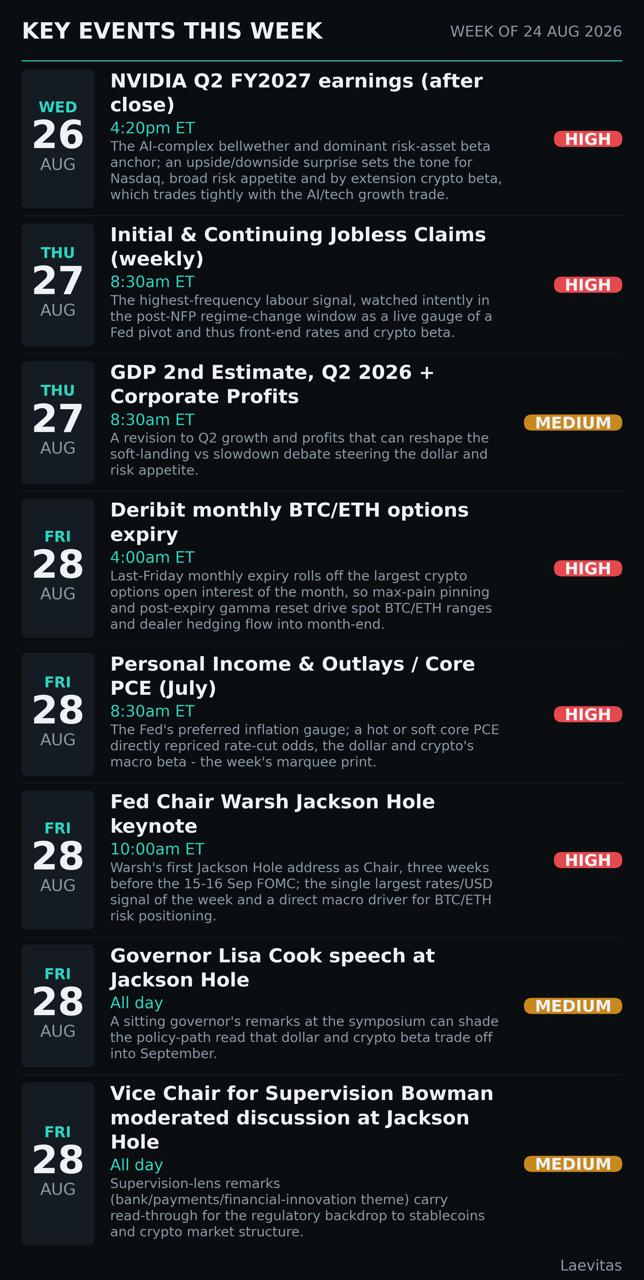
Macro
The dominant cross-asset tension remains a market priced close to perfection: US financial conditions at their most accommodative since the mid-1990s and equity vol near the year’s lows, set against inflation still above target with June core PCE around 3.7% and CPI near 3.5%, and a curve pricing only a shallow hike path of roughly 31bps by December. The historical record argues that inflation starting a cycle above 3% has tended to force far more tightening than that, on the order of 100bps in a first year, which leaves the hawkish tail underpriced and the equilibrium internally unstable.
Last week the market resolved that instability through the real-asset channel rather than a rates shock: the long end stayed pinned near multi-decade highs with 30y around 5.28%, its highest since 2007, gold added 5.6% to roughly $4,700 in a third straight weekly gain, and $BTC ran some 24% to around $77,500 while $ETH outpaced it at 34% - driven by a regulatory-clarity push in Washington, a multi-day spot ETF inflow streak running $298MM to $606MM to $307MM across 17-21 August, and a short squeeze through $69k. The cleaner read on gold and long-end yields rising together is Treasury-led financial repression, with buybacks weighing on the front of the curve and the dollar under a debt-management framing rather than outright QE, and fading rate-cut bets doing the rest. Jackson Hole is the fulcrum; Warsh’s first keynote as Chair, paired in the same late-week window with July PCE, either validates the sticky-long-end regime or breaks it, and a hawkish framing that rejects the old rate-cut lens would hit gold, crypto and long bonds simultaneously given how crowded that real-asset trade has become.
Underneath the macro print sits the equity swing factor, with NVDA reporting midweek into a Nasdaq that has taken two down weeks, the two-way risk being that rising long-term yields threaten the debt-funded AI-capex boom even as a strong print would re-anchor the broadening-tech narrative. The dollar softened broadly, with EUR/USD up 1.3% to 1.1667, but the structural case still points to it re-accelerating once conditions outside the US turn, so the crypto tailwind from a soft dollar is best treated as a pause in the dollar’s structural strength, with a firmer dollar on a hawkish Warsh the cleaner near-term risk. A fresh geopolitical leg has entered through the Middle East, with Brent topping roughly $93 overnight and crude, gold and $BTC all catching the same bid, while China offers no offsetting easing impulse; the PBoC has formalised a framework that puts a firmer floor under overnight rates and is expected to hold policy through the year.
Crypto
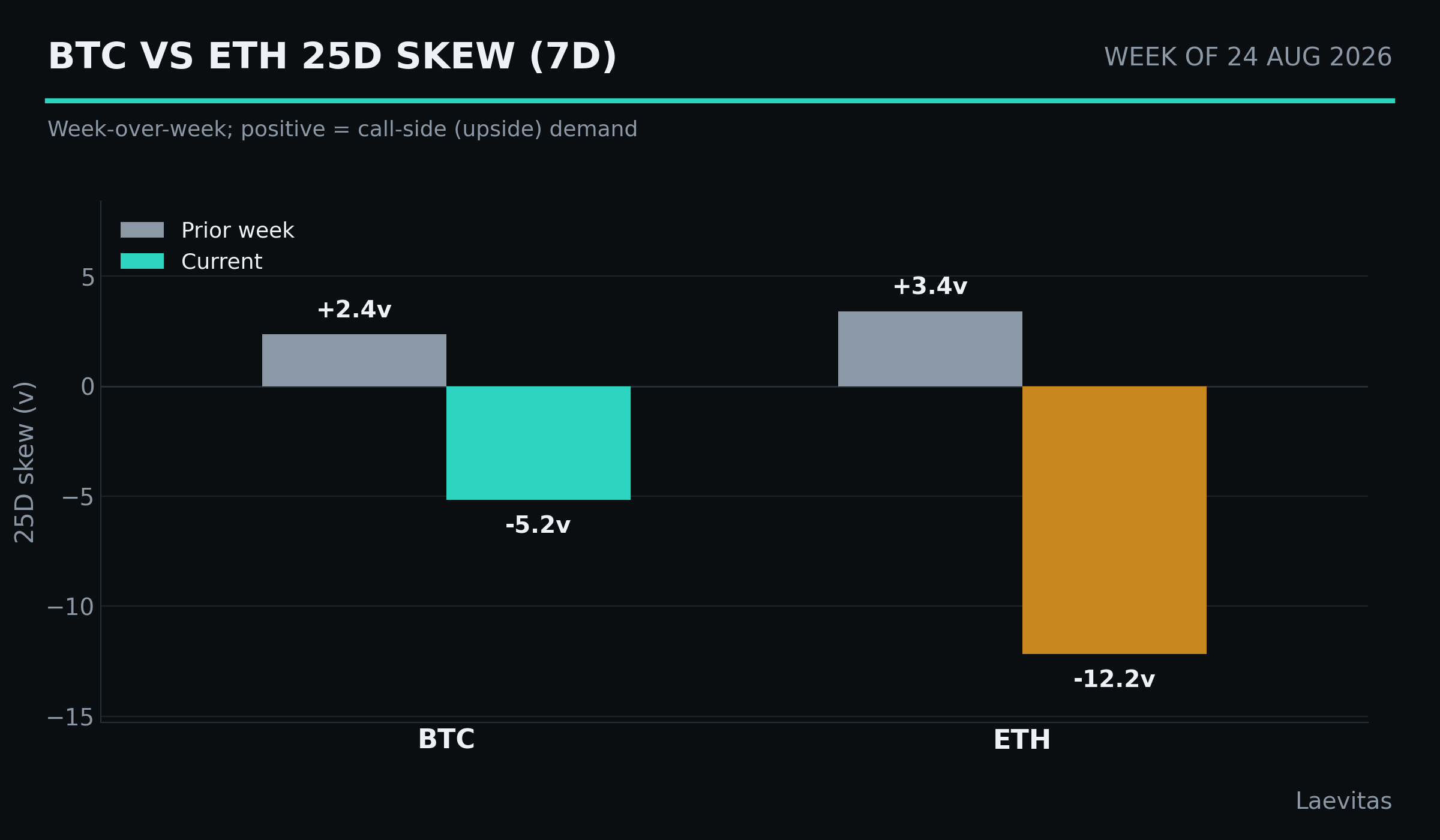
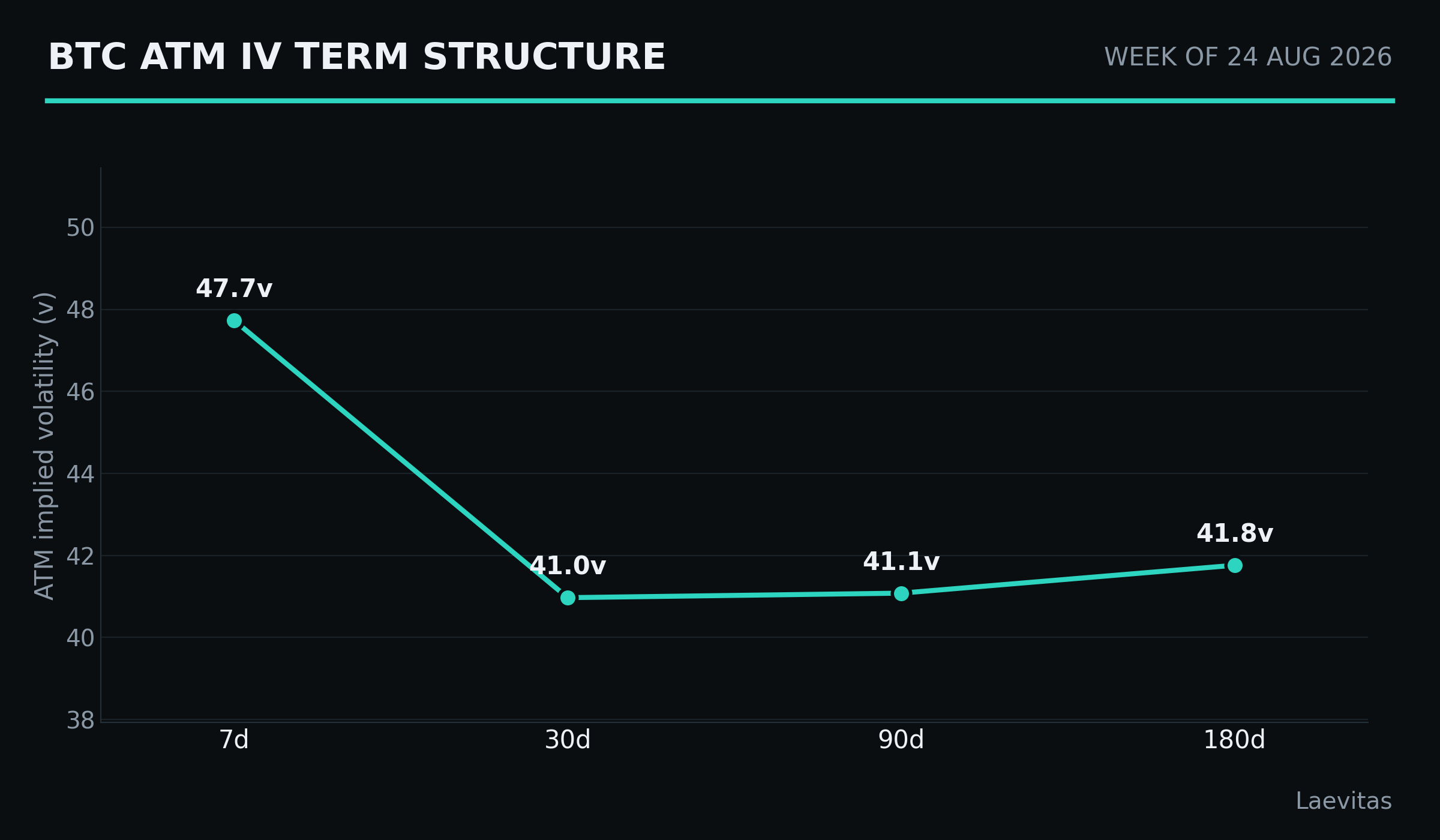
The derivatives surface has flipped defensive even as spot rose, and the move is in the skew. $BTC 25D 7d skew ripped from +2.36v to -5.17v over the week, a 7.5v swing, while $ETH’s went further, from +3.41v to -12.17v, a 15.6v collapse into puts. That reads as downside protection being bid aggressively after a violent rally that has since stalled in the high 70s, with the surface pricing the wall of event risk into the back half of the week rather than a breakdown in the tape. Front-end implied vol confirms the shift: $BTC 7d ATM IV roughly doubled from 26.5v to 47.7v and $ETH’s from 35.8v to 68.0v, dragging the term structure into backwardation with $BTC 7d ATM at 47.7v against 41.0v at 30d and $ETH 7d at 68.0v over 57.9v.
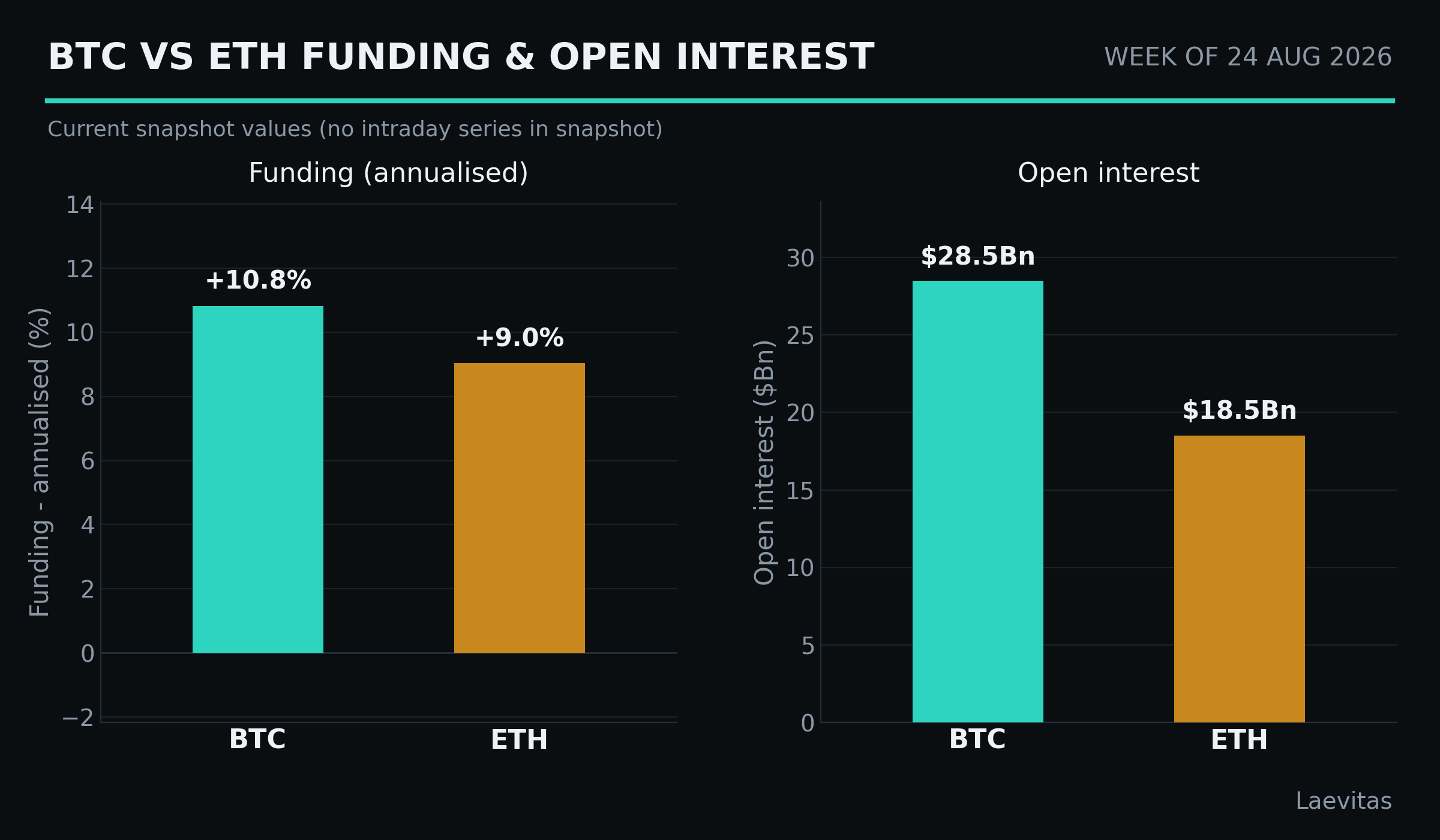
The realised-vol picture argues the front-end is still not expensive relative to what is being delivered: on the IV-RV construction $BTC 7d realised is running 55.4v against 46.6v implied, and $ETH 82.0v over 67.0v, so short-dated optionality screens cheap to what the tape has actually printed even after the vol repricing. That matters because the Deribit monthly expiry falls on Friday 28 August, the same session as the Warsh keynote and July PCE, concentrating gamma and event risk into a single window and giving the front-end kink its shape. Funding has firmed with the rally, $BTC perps at 10.8% annualised from 6.7% and $ETH at 9.0% from 5.9%, leaving longs paying up into that risk with $BTC OI around $28,480MM and $ETH near $18,516MM.
The market is positioned for a benign resolution - a Warsh keynote that soothes more than it threatens and a July PCE that does not force the issue - which would re-arm the risk rally and let the compressed skew normalise. The asymmetry runs the other way: vol is cheap in equities, the real-asset trade is crowded across gold, crude and crypto together, and a hawkish Warsh or a hot PCE would hit all three legs at once while long-end yields already sit near multi-decade highs. The derivatives market has partly pre-empted this by bidding front-end protection and inverting the curve, and the open question is whether a 7d ATM near 48v on $BTC is fair or still light for a single session carrying a monthly expiry, a first-of-tenure Jackson Hole keynote and the year’s most-watched earnings print; with realised still running over implied, the balance of evidence leans towards the front-end being reasonably priced rather than rich.
Positioning into the week
- Front-end convexity into the 28 August cluster: with $BTC 7d ATM IV having roughly doubled to 47.7v yet 7d realised still 55.4v over 46.6v implied on the IV-RV construction, short-dated optionality continues to screen cheap against delivered vol ahead of Warsh, July PCE and the Deribit monthly expiry landing in one session.
- Downside skew as the event hedge: $ETH 25D 7d skew having collapsed from +3.41v to -12.17v in a week prices an aggressive bid for protection that only normalises if Jackson Hole and PCE clear without a hawkish repricing.
- Term-structure inversion: $BTC 7d ATM IV at 47.7v against 41.0v at 30d reflects the event premium concentrated in the Warsh, PCE and NVDA window and flattens back once that risk passes.
- Real-asset beta versus the dollar: $BTC up 24% on the week alongside gold and crude leaves crypto embedded in the debasement trade, its continuation contingent on the dollar staying soft rather than re-accelerating on a hawkish Warsh.
- Funding-led long risk: $BTC perp funding at 10.8% annualised and $ETH at 9.0% show longs paying up after the rip, a configuration that compresses quickly if the high-70s consolidation rolls over into the event risk.
Week ahead | 2026-08-24 | Derivatives via Laevitas