
The Monday Brief // 07Sep26
Rick @scopicview - Head of Markets, Laevitas
Friday’s payrolls print landed stronger than expected and tilted an already contested September FOMC further towards a hike. That firmness arrived at the end of a week in which market-implied odds of a 16 September hike swung from 70% on 1 September, after Barr’s remarks that the Fed should act decisively if inflation fails to moderate, to a peak above 72% mid-week and back to 50/50 on 3 September once Waller argued publicly for giving disinflation a chance. The committee is arguing in the open about whether to tighten, with August PPI on Thursday and August CPI on Friday standing as the deciding inputs.
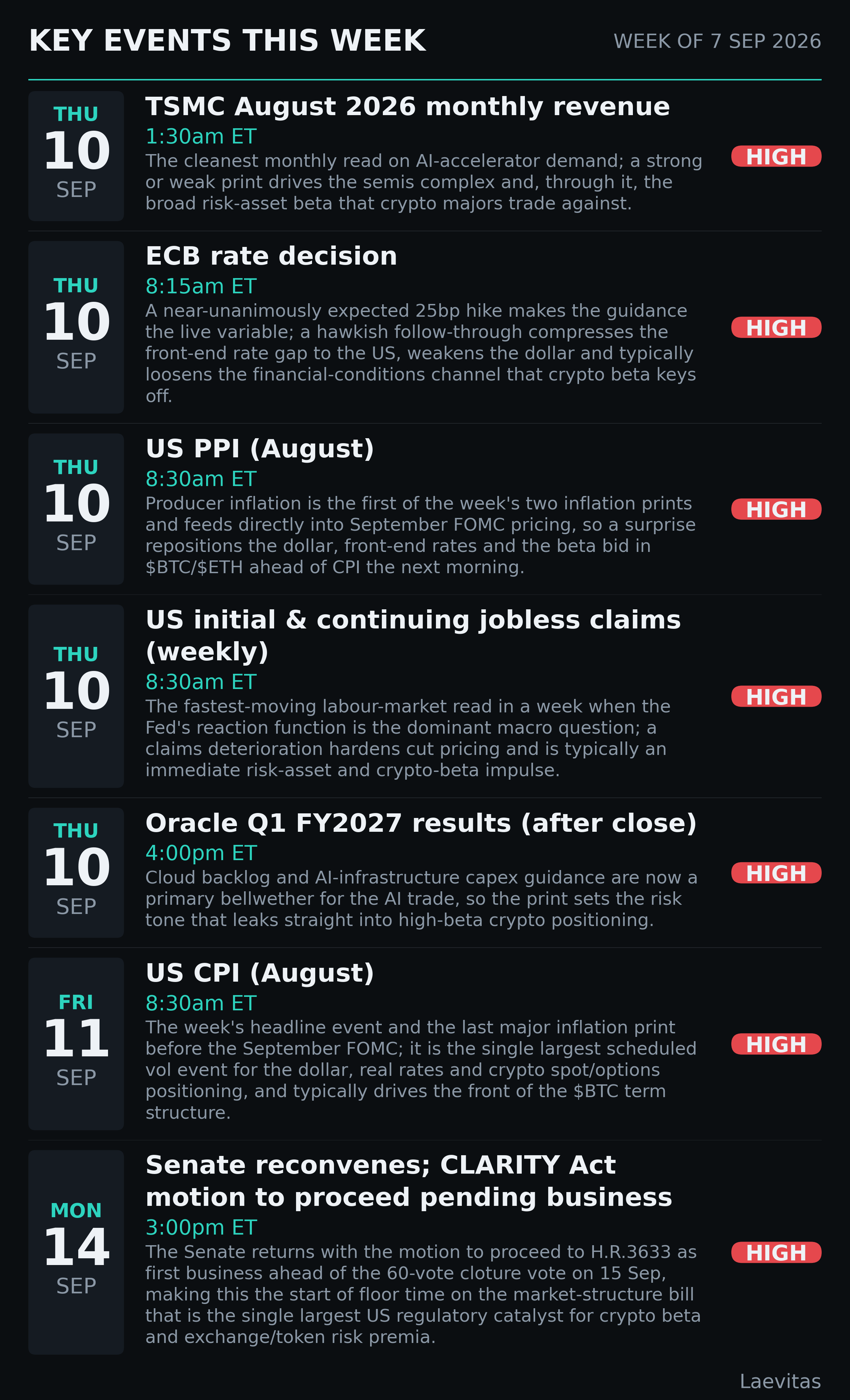
Key events this week
Macro
The Fed’s internal split runs through everything else this week, and it is unusual in both direction and visibility. A committee that was assumed eighteen months ago to be easing is now debating a hike, with Warsh hawkish, Waller pushing back, and five officials in total - Warsh, Waller, Cook, Jefferson and Barr - having signalled at least conditional support for tightening. The oscillation between 70% and 50/50 across 1-3 September came from a speech and an interview moving the same unresolved question in opposite directions, and it leaves the 16 September decision nine days out from Monday with the deciding inputs, PPI and CPI, still unpublished. Positioning reflects that irresolution honestly, with an unusually large share of rates investors unwilling to call the next fifteen basis points in 10s at all.
Underneath the Fed argument sits a global bond selloff that has carried 10-year Treasury yields above 4.75% for the first time since January 2025, with an intraday print near 4.816% before settling around 4.77-4.78% into the end of last week. The move is broad, spanning maturities, forwards, breakevens and real rates, and the expanded Treasury buyback programme has not changed its fundamental drivers; 30-year yields sit back near where they stood when the expansion was announced on 19 August. What has kept risk assets comfortable through it is the behaviour of rates volatility, which has stayed contained in both realised and implied terms even as term premium has rebuilt - a combination that resembles the pre-GFC regime and explains why higher yields have been absorbed rather than transmitted. That mechanism is a general risk-asset one, and it puts rates volatility ahead of the yield level as the variable that has done the work.
Energy pushes the inflation prints in a hawkish direction without deciding the meeting itself. WTI crossed $90/bbl on 1 September for the first time since 24 July on concerns about flows through the Strait of Hormuz and closed above that level for a second consecutive session on 2-3 September, which is the most recent hard crude level available; European gas has since made fresh highs. The survey data already carries the impulse, with ISM Services prices paid jumping to 72.6 from 70.3 on 3 September and manufacturing input costs at 71.1. Elsewhere in the G3 the picture is far less ambiguous: a BoJ hike in September is treated as effectively done and fully priced, with the pace thereafter the live variable, and the ECB is expected to deliver a second 25bp hike at Thursday’s meeting alongside fresh staff projections. The rate-cut regime that underpins most crypto valuation frameworks built in 2024-25 has been replaced by a tightening bias across all three major central banks, and that re-basing has further to run.
Crypto
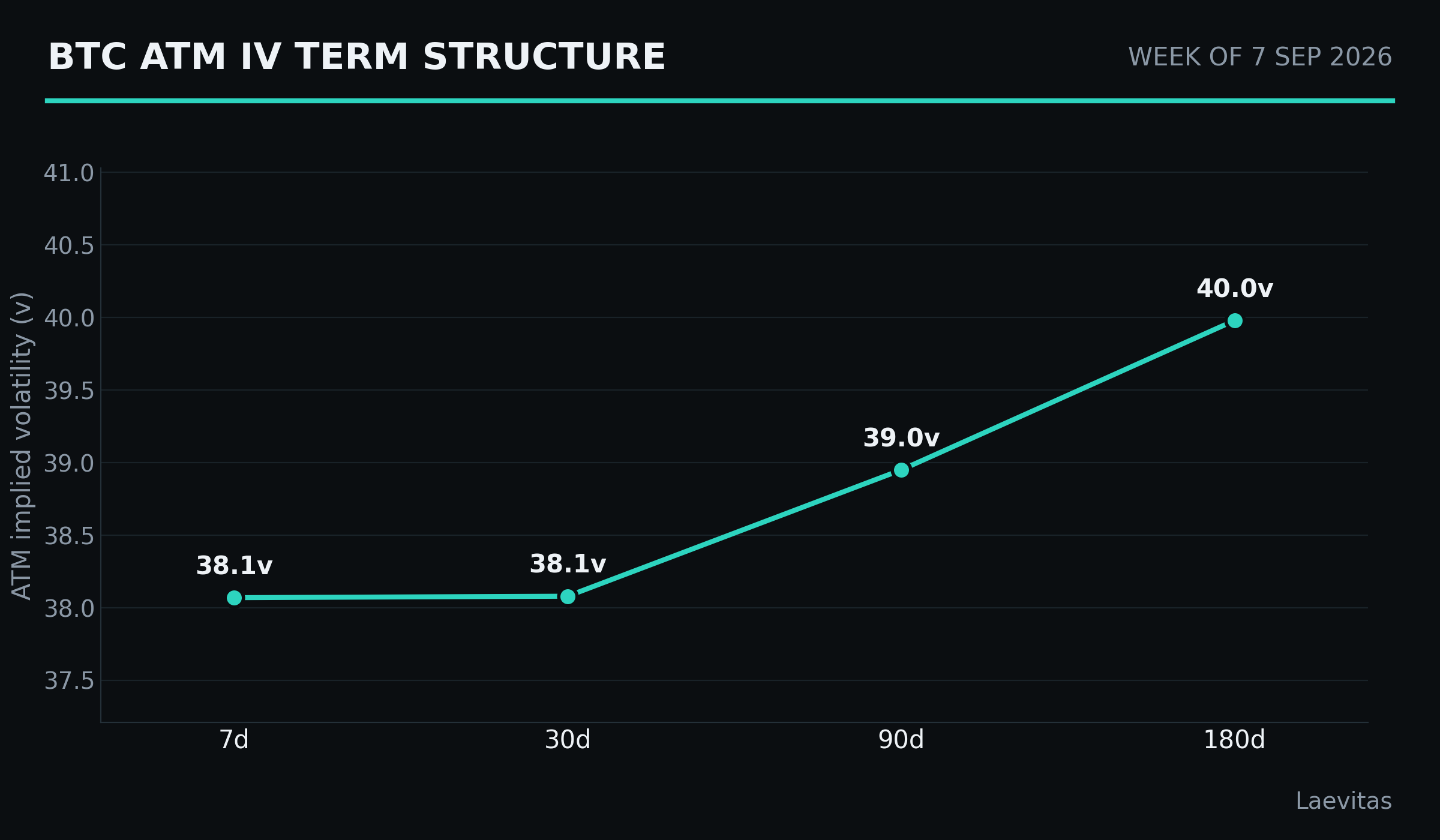
The vol surface has repriced the front of the week hard and left the back largely alone. $BTC term-structure ATM IV sits at 38.1v at 7d against 38.1v at 30d, 39.0v at 90d and 40.0v at 180d, a curve that is flat across the front and gently upward-sloping thereafter. The 7d window runs through 14 September and covers PPI on Thursday and CPI on Friday, while the FOMC on 16 September sits on the 30d leg, so the flat front carries no read on the meeting. What the front does carry is four sessions of aggressive markup into the two inflation prints: 7d ATM IV has run from 30.4v on 3 September to 38.1v today, a rise of 7.6v, against 3.6v at 30d, 1.2v at 90d and 0.4v at 180d over the same stretch. The flatness comes from the front converging upward on the back, and the path getting there was unstable - 37.7v on the 4th, 32.0v on the 5th, 35.4v on the 6th. $ETH prices a different shape entirely, with 7d ATM IV at 55.0v inverting against 50.4v at 30d before the curve recovers to 52.9v at 90d and 54.3v at 180d, so $ETH carries an outright front-end inversion where $BTC has merely flattened.
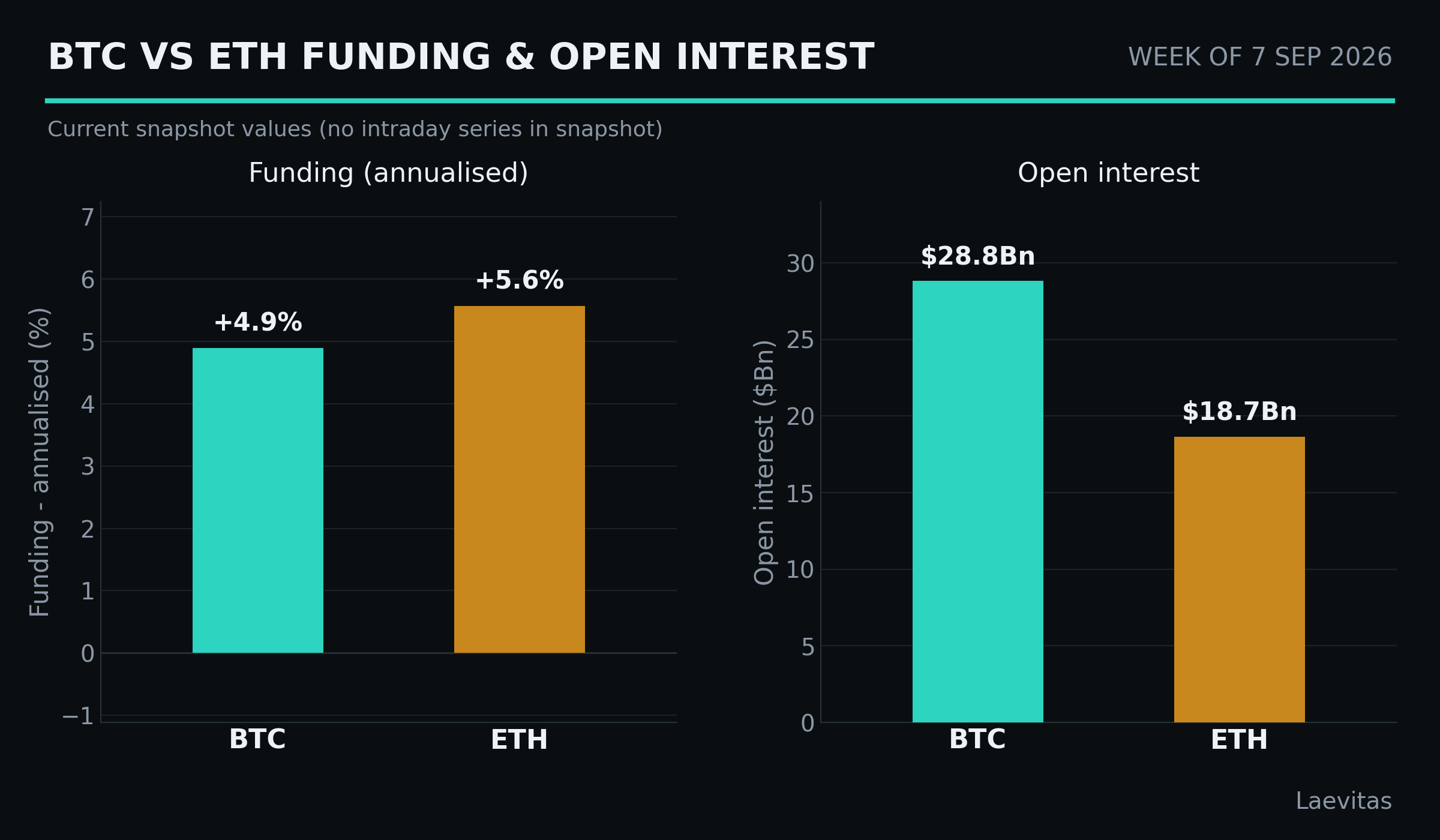
The realised-premium read sharpens the same picture. On the IV-RV construction, $BTC 7d realised sits at 36.1v against 42.8v implied, a 6.7v premium, with the 30d leg at 38.2v realised against 42.4v implied; $ETH runs the other way, with 7d realised at 47.7v above 46.4v implied and the 30d gap far wider at 52.3v realised against 42.8v implied. Perp positioning has not changed in size even as its cost has fallen: $BTC funding has compressed from 10.8% to 4.9% annualised week-over-week and $ETH from 7.5% to 5.6%, while open interest is effectively unchanged at $28,813MM in $BTC and $18,659MM in $ETH, so the notional leverage a liquidation would consume is the same as it was a week ago and only the carry on it has cheapened. The week’s structural dates sit awkwardly around the data: the Deribit weekly BTC/ETH expiry rolls off at 04:00 ET on Friday 11 September, roughly four and a half hours ahead of CPI and some nineteen and a half hours after Thursday’s PPI, so the dealer positioning that expires does so between the two prints. The Senate then reconvenes on Monday 14 September with the CLARITY Act motion to proceed as pending business and a 60-vote cloture threshold on the 15th, which is the largest US regulatory catalyst in view for crypto beta and for exchange and token risk premia, and it lands the day before the FOMC.
$BTC front vol has been marked up 7.6v in four sessions and still carries a 6.7v premium of implied over delivered on the IV-RV construction, so the week is already being charged for at the front. $ETH is bid and inverted on the term structure, at 55.0v against 50.4v at 30d, while on the IV-RV read its 7d implied of 46.4v sits under 47.7v realised, so the two constructions disagree about whether that front is expensive. The condition under which the $BTC reading fails is a CPI print that resolves the September hike decisively in either direction, since a surface that added 7.2v in a day on 4 September and gave back 5.7v the day after can deliver more than 38.1v discounts, and the flat 30d leg would then have to reprice for the meeting across the three trading sessions between the CPI print and the decision. Working against a straightforwardly bearish crypto view is that risk assets have absorbed the entire global bond selloff without incident so long as rates volatility stayed contained, and nothing in that channel has broken yet.
Positioning into the week
- $BTC front-end vol into the inflation prints: 7d ATM IV has been marked up 7.6v in four sessions to 38.1v and now sits level with the 30d leg, with the IV-RV read carrying a 6.7v premium of implied over delivered, so the front is charging for the week; that level is only cheap if CPI moves spot beyond what a 38.1v surface discounts.
- $ETH front-end vol against $BTC: $ETH 7d ATM IV at 55.0v inverts against its own 50.4v at 30d while $BTC prices the two legs flat, a relative-value gap that closes if the $ETH front-end bid decays without a catalyst.
- $ETH perp carry into the week: funding at 5.6% annualised still pays shorts, though about a quarter less than it did a week ago, and open interest at $18,659MM is unchanged week-over-week, so the size of the position that could unwind is unchanged even as it costs less to hold.
- Rates volatility as the crypto drawdown trigger: the global selloff that took 10s above 4.75% has been absorbed by risk assets only because realised and implied rates vol stayed contained, and a breakout there changes the regime crypto has been trading inside.
- Regulatory event risk into 14-15 September: the CLARITY Act cloture vote falls the day before the FOMC, layering a US crypto-specific catalyst onto the meeting that the 30d tenor already spans.
Week ahead | 2026-09-07 | Derivatives via Laevitas