
The Monday Brief // 14Sep26
Rick @scopicview - Head of Markets, Laevitas
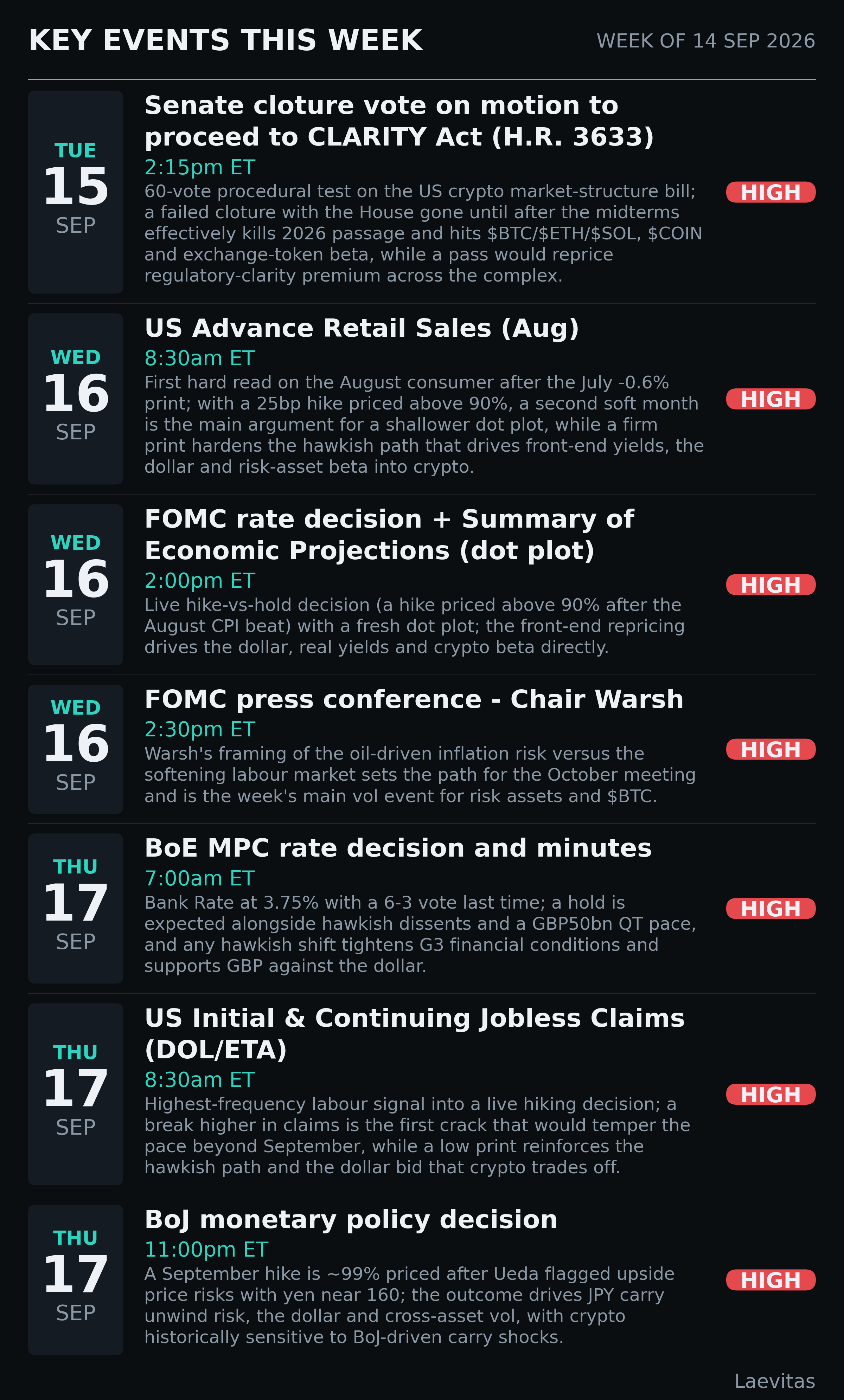
Last week’s pivot resolved on the hawkish side: August core CPI landed hot against a 20bp consensus, and pricing for Wednesday’s FOMC moved north of 90% for a 25bp hike, the first step in what rates markets are now treating as a cycle. Energy remains the transmission channel, with Brent trading through $100 on 9 Sep and printing a $107 intraday high on Thursday 10 Sep before sliding some 3.5% into the weekend to just below $104 on reports that a bloc of Gulf states may meet Iranian officials over the Strait of Hormuz this week. With the ECB having delivered its second 25bp hike on 10 Sep, the BoE and BoJ both deciding within hours of each other on Thursday, and the Senate taking a cloture vote on the CLARITY Act on Tuesday, the week is loaded on the macro and the crypto-native side alike.
Key events this week
Macro
The 25bp itself is settled; the event risk on Wednesday sits in the Summary of Economic Projections and in Warsh’s press conference, because the committee has been arguing in public. Warsh called 2% a "firm, fixed target" at Jackson Hole, Barr wants to "act decisively" if inflation fails to moderate, and Waller’s "give disinflation a chance" took hike odds from 72.6% to 50/50 inside 48 hours at the start of the month before the CPI print ended the debate in market terms. Current pricing still implies an unusually shallow cycle for the starting conditions - ISM services prices paid at 72.6 is a four-year high, and core PCE is tracking around 26bp for August - so a dot plot that implies more than a couple of further hikes would extend the belly selloff that is already the cleanest expression of the regime. The dissent worth holding is on the CPI internals: roughly 8bp of the core beat came from a one-off jump in wireless services while shelter, medical and insurance were soft, and the growth data underneath are deteriorating (UMich at 47.8 against 51.0 expected, ADP at 38k, the lowest since January), which gives Warsh room to frame September as a measured step if he wants it.
The long end has tested the idea of a Treasury put and found it small. The 10y reopening stopped at 4.834% and the 30y at 5.308%, and a $6bn buyback envelope with only $5.187bn executed on 10 Sep catalysed a further leg cheaper rather than a rally; with 10y real yields near 2.4%, the duration selloff has been global, broad and orderly, which makes it harder to argue the move is unsustainable without a change in the fundamentals. The quieter headwind for crypto sits in Q4 funding: cumulative bill issuance, a Treasury cash balance near $1trn and the pause in reserve management purchases all point to dollar liquidity tightening into year-end regardless of what the policy rate does on Wednesday. Risk assets have absorbed this without a disorderly break so far, with the S&P 500 giving back 48-58bp on each of the three most oil-driven sessions last week while credit and MBS spreads remain historically tight on inflows; the pricing of persistent growth, modest hikes and a fading supply shock is a narrow landing zone, and the sensible response is to keep the long but pay for convexity.
The yen is the most-argued cross-asset trade of the fortnight, and it matters for crypto as a funding-currency event. A BoJ hike late Thursday (New York time) is close to fully expected, two board members have escalated their rhetoric, Bessent has dared traders to bet against the currency ("the house now"), and Norway’s $2.2trn sovereign fund has proposed shifting roughly $20bn out of Treasuries into JGBs on an explicit re-appraisal of sovereign risk; the honest counter is that the hard flow data through August show trust accounts still buying foreign bonds, so the reallocation is speculation for now, with the pace after September the real question. The dollar carries two faces into the week: a cyclical bid from the hike and the oil shock, and a structural erosion argument that the same administration is answering with stablecoins and tokenisation as the rails for an $800bn AI capex year, which is the frame in which Tuesday’s CLARITY Act cloture vote belongs. On the cross-asset scoreboard $BTC sits at the top of the one- and three-month rankings alongside oil and at the bottom of the year-to-date and twelve-month tables, a sharp rally on a deeply negative base, and the near-term set-up is a real-yield and liquidity headwind laid over a policy-backed adoption tailwind.
Crypto
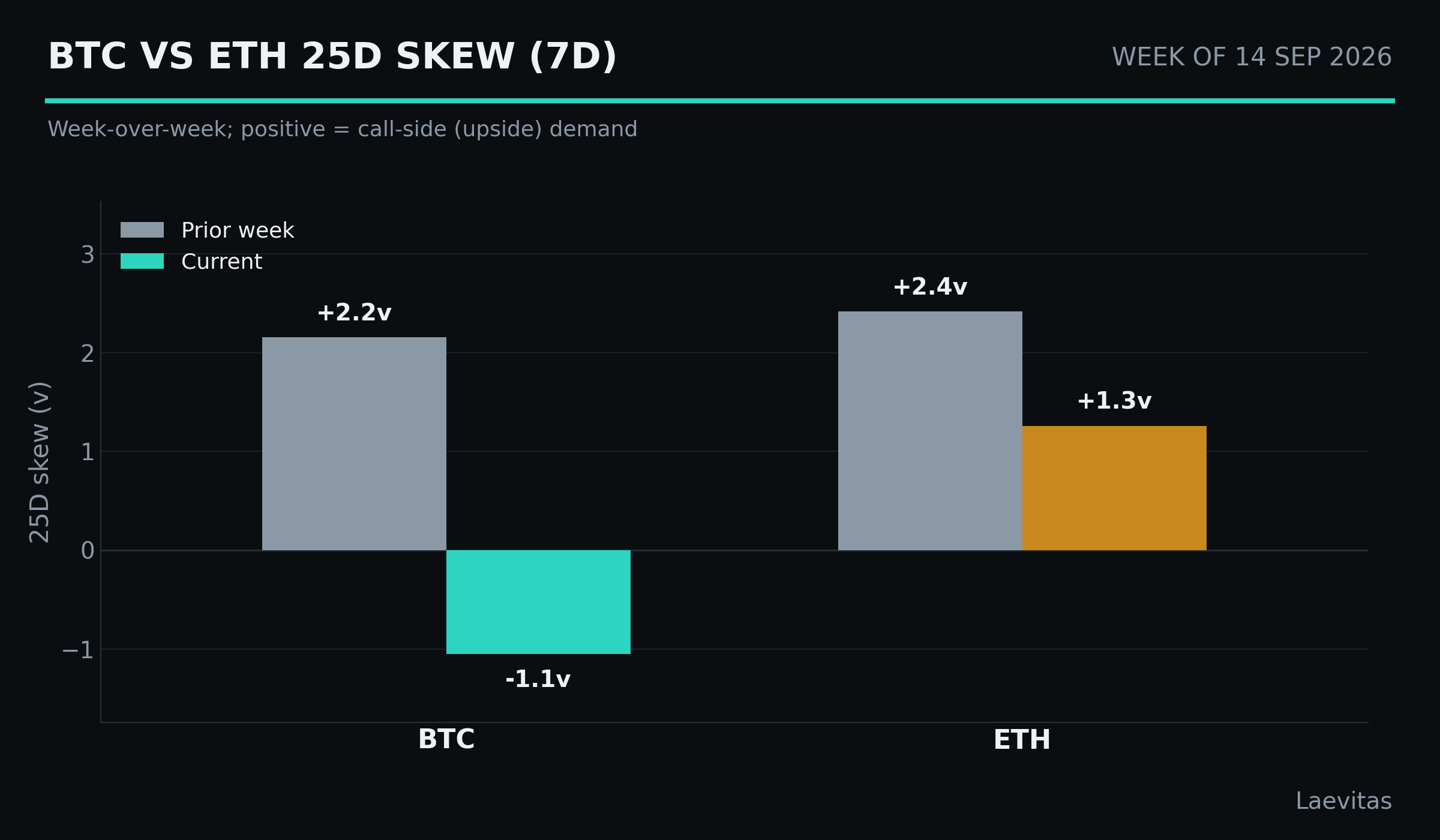
The week’s move on the surface is in skew. $BTC 7d 25D skew went from +2.16v to -1.05v (-3.21v WoW) and 30d from +1.33v to -1.39v (-2.72v), so the put wing is now the marginally richer side on both tenors, with $ETH 30d following from +1.26v to -0.60v while its 7d held a call bid at +1.26v, down from +2.42v. The context tempers the headline: both $BTC tenors still sit around the 90th percentile of their 52-week range against medians of -4.42v and -4.70v, and $ETH at the 92nd-95th percentile against -3.91v and -3.64v, which makes this a retracement from a call-bid extreme toward a surface that remains unusually flat for a live FOMC week, and the downside hedge is being added at levels that would have screened as complacent through most of the past year. Butterflies are mid-range ($BTC 0.98v at 7d and 1.03v at 30d, $ETH 2.05v and 1.65v), so the wings are being bought quietly rather than in a hurry.
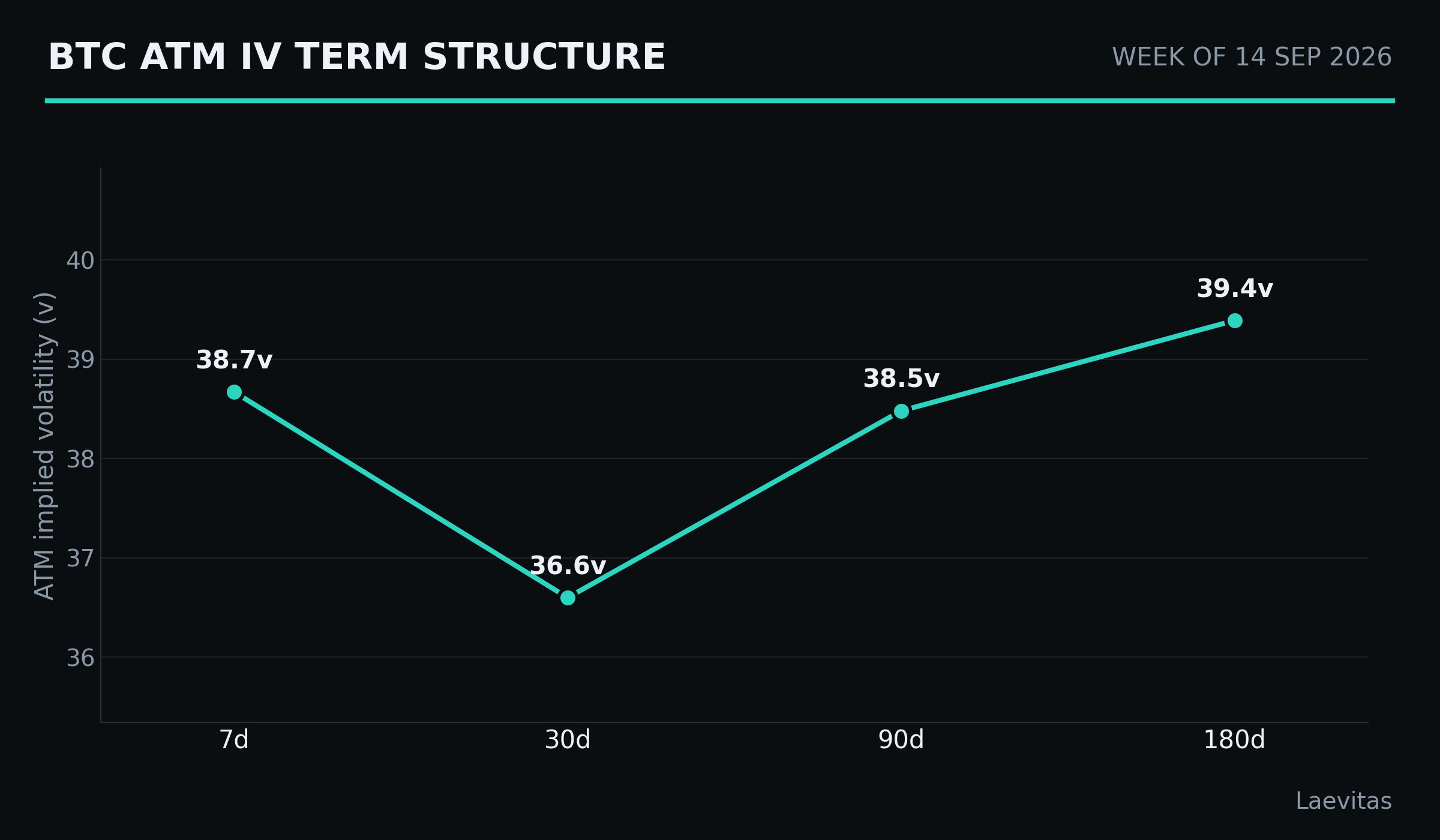
$BTC term structure carries a front-end kink, with 7d ATM at 38.67v over 30d at 36.60v, then 90d 38.48v and 180d 39.39v, so the curve inverts across the front month and slopes gently upward from there. The 7d point was crushed from 40.2v on 11 Sep to 34.5v the day after CPI and rebuilt to 38.7v by Monday as Wednesday’s decision rolled into the one-week window, which is event premium being reloaded. On the IV-RV construction the front is the expensive part of the surface, 7d realised 30.7v against 38.4v implied for $BTC (a 7.7v premium), while 30d realised 39.9v runs over 36.1v implied, the 30d spread having flipped from +4.13v to -3.80v in a week; $ETH is cheaper still, 7d realised 52.8v against 52.0v implied and 30d 56.8v over 50.9v, so one-month optionality on both majors is being offered below what the last month actually delivered, into a hike, an oil shock and a Q4 liquidity drain. Perps show where the leverage is building: $ETH funding stepped from 5.6% to 8.5% annualised with OI up 4.0% WoW to $19,398MM and a long/short ratio of 1.37, against $BTC funding at 5.2% (from 4.9%), OI flat at $28,727MM (-0.3%) and a 0.89 long/short, which leaves $ETH as the crowded leg into Wednesday with the weekly Deribit expiry on Friday as the first clearing point after the presser.
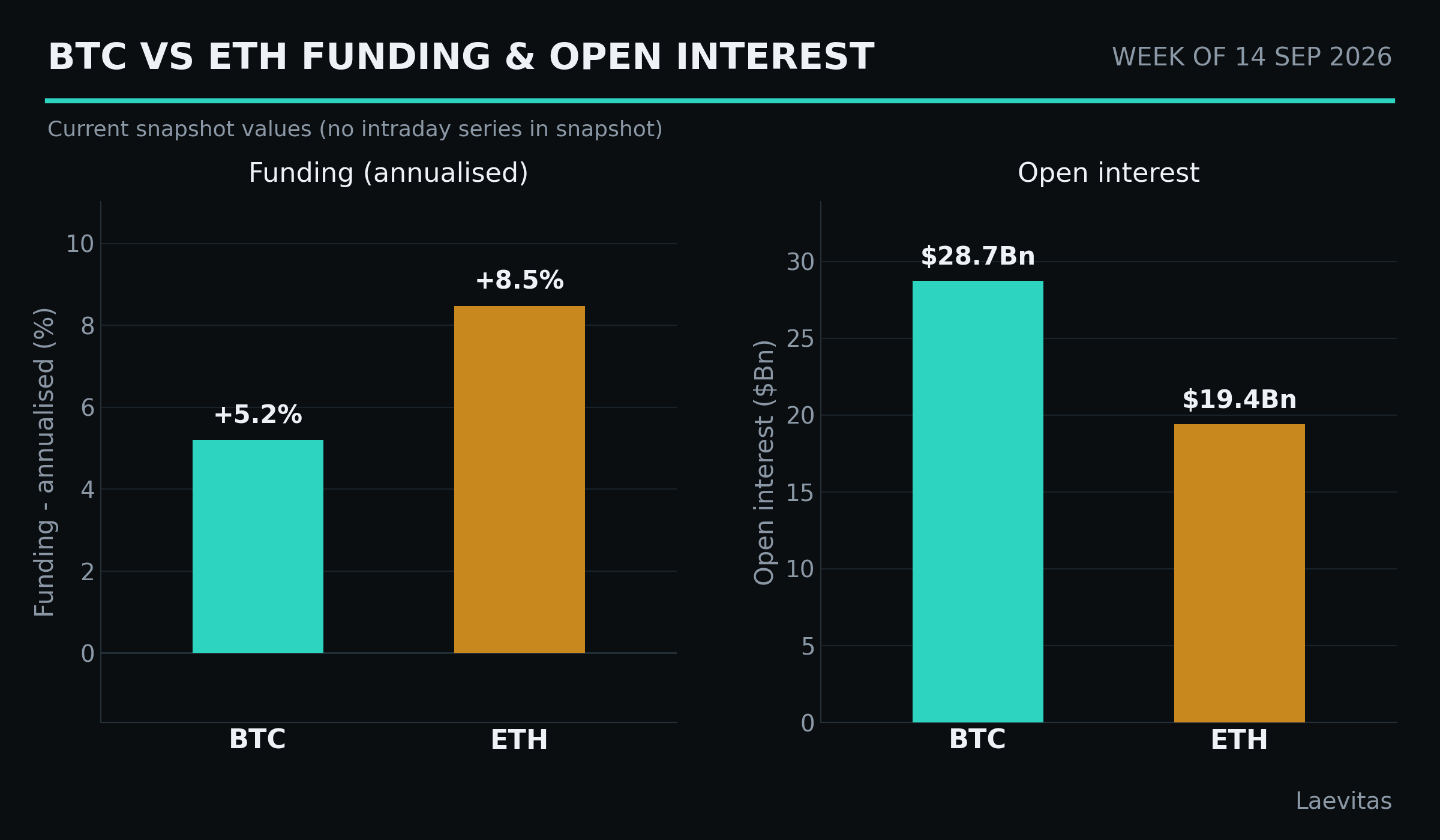
The tension for the week is that the surface is pricing a fully absorbed hike while the rest of the macro grid is pricing the start of a cycle. Thirty-day implied below realised on both majors, a skew that has only just crossed to a put bid from a call-bid extreme, and $ETH longs paying 8.5% annualised at a 1.37 long/short is a configuration that screens as cheap to fade if the dots extend the cycle and the belly selloff resumes; the other reading is that rates positioning is light and reactive, the CPI internals were soft, and a Warsh presser that leans on the one-off categories would take real yields lower and reverse the skew move as quickly as it arrived. Either way, the asymmetry sits in the one-month optionality being offered below delivered volatility, with the cost of holding it through the event the only real bleed, and a Hormuz headline that takes Brent back through the $96 level of early September the single largest reversal risk for every leg of the macro trade.
Positioning into the week
- Cheap 30d optionality into the dots: $BTC 30d implied at 36.1v under 39.9v realised and $ETH 50.9v under 56.8v on the IV-RV read is the configuration that screens as cheap to own through Wednesday, with the 30d skew flip to -1.39v placing the put wing at a price that still sits well above its 52-week median put bid.
- $ETH leverage as the fragile leg: funding at 8.5% annualised, OI up 4.0% WoW to $19,398MM and a 1.37 long/short make $ETH perps the crowded side of the FOMC, and a hawkish SEP that extends the belly selloff would find the unwind there before it reaches $BTC at 5.2% and 0.89.
- Front-end event premium: $BTC 7d ATM at 38.67v over 30d at 36.60v against 30.7v realised is the expensive part of the surface, and that premium decays into Wednesday’s decision unless the presser reprices the cycle beyond a single step.
- Oil as the master reversal: a Gulf-Iran meeting that takes Brent back through the $96 level of early September would remove the energy channel that pushed hike pricing above 90%, reversing the rates, dollar and skew moves together.
- The yen as the carry event: a BoJ path faster than the market assumes, alongside any confirmed domestic rotation into JGBs, would be a funding-currency shift that hits leveraged carry across assets, crypto perps included, and the flow data through August give it no support yet.
Week ahead | 2026-09-14 | Derivatives via Laevitas