
The Monday Brief // 21Sep26
Rick @scopicview - Head of Markets, Laevitas
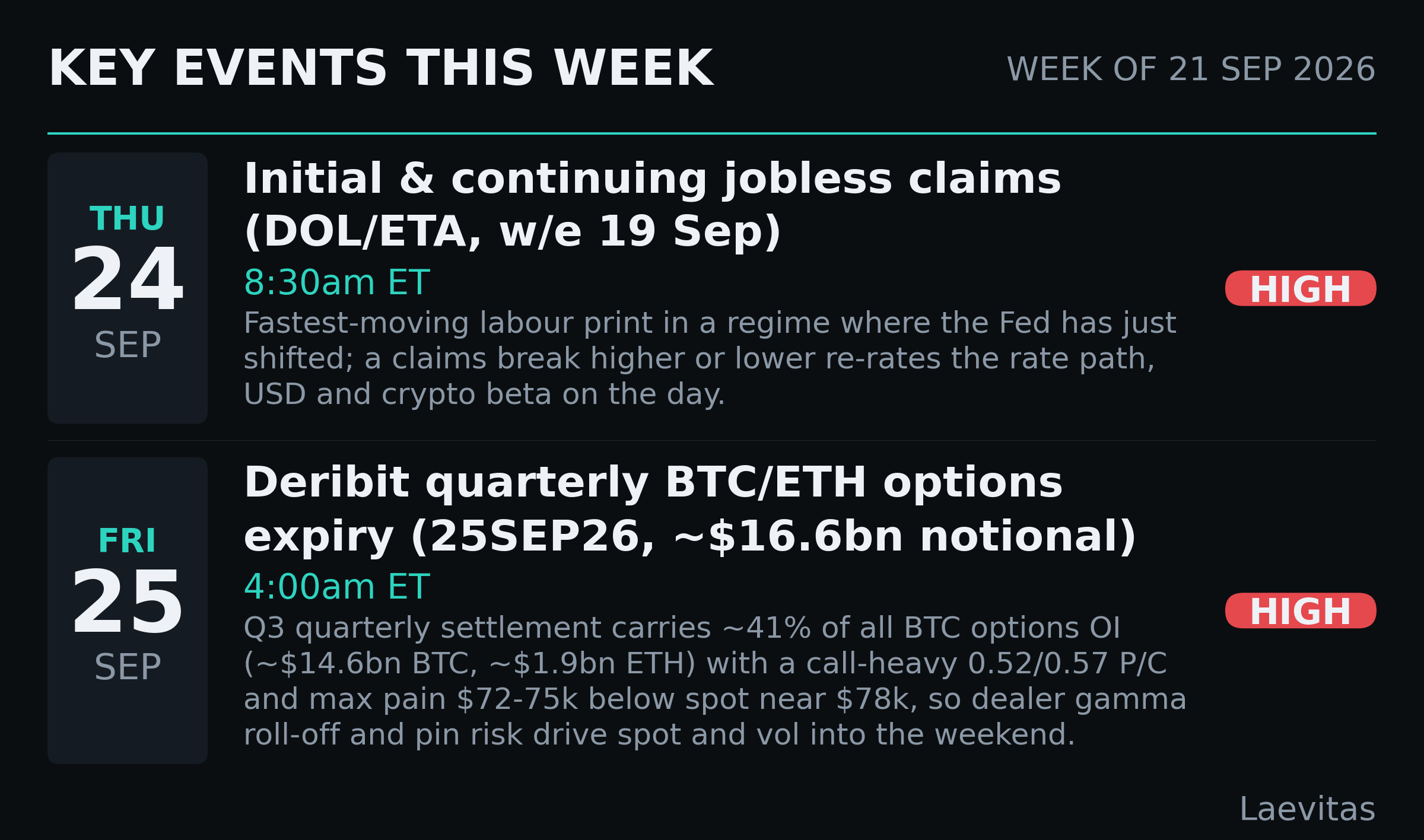
Last week’s flagged pivot resolved on the hawkish side, with the FOMC delivering the 25bp hike, its first since 2023, against roughly 23bp priced going in, and framing it in language firm enough that a second 25bp move in October has become the base case. The BoJ followed with 25bp of its own to a 31-year high, though two dovish dissents and the absence of guidance for October sent USD/JPY back towards 158 from the sub-153 print of a fortnight earlier, while the BoE held at 3.75% on a 6-3 vote and overhauled its QT programme. Beneath all of it, Brent is back above $108/bbl after Saudi Arabia closed its East-West pipeline and then told European refiners to expect no crude next month, which is the thread that carries into a week of Fed speak, a Trump meeting with Gulf leaders on the sidelines of the UN General Assembly on Tuesday and the Deribit quarterly expiry on Friday.
Key events this week
Macro
Four central banks moved inside a single fortnight, and the more important observation is that each of them was still being priced late right up to the decision. The Fed went from roughly 60% odds in early September to near-certainty only after the August CPI beat, and then delivered a unanimous hike to 3.75%-4.00% with broad committee support for a second move this year and a cluster of 2027 projections at 4.25%-4.50%; the ECB’s move to 2.50% was described by its own president as obvious, and the BoJ’s 1.25% is the highest in three decades. The pattern of a market repeatedly under-pricing hawkishness is the dissent worth holding this week, because the front end has repriced to something close to fair on a 95bp-through-2027 view while the inflation configuration (ISM services prices paid at a four-year high, energy still feeding through) argues for a cycle deeper than that. Chair Warsh’s line that the Fed would not outsource inflation control to the bond market reverses the July framing, and the first post-hike speaking schedule - Williams twice, Jefferson, Goolsbee, Barkin, Barr and Hammack, with Lagarde on Monday for the European side - is where that reaction function gets tested against a data slate thin enough (flash PMIs, claims, durable goods, the UMich final) that the speakers will carry the week.
Oil is the variable the whole complex keys off. Brent has gone from $96/bbl at the start of the month to a $109.5 high on the 15th, the 10y touched 5.04% the same day, and the futures curve is still pricing a fade in the Hormuz disruption that has failed to arrive for six months running, which means even flat energy prices from here would force a repricing elsewhere. The relief signals (Saudi non-Hormuz sales ramping, half the pipeline’s capacity possibly back within days, Trump’s Iran diplomacy posts) have each gone uncorroborated within a session, and Friday’s Saudi warning to European refiners was the latest reversal of them; Tuesday’s Gulf meeting is the one scheduled event this week capable of moving that input. The long end has no rescuer on the supply side either - the $6bn buyback envelope was nowhere near the incremental duration coming from AI capex, and only $5.187bn of it was used - so a 10y meaningfully below 5% needs better inflation data or a worse growth picture, and the second of those is no friend to crypto beta.
The post-FOMC dollar bid is real, though the administration’s preference for a weaker currency and carry positioning already rotated toward AUD, NOK, MXN and BRL mean the hawkish repricing supports it without running far; DXY’s cycle peak a little above 101 against 115 in 2022 is the reference for that ceiling. The yen is the cleaner read on the regime, because the sub-153 rally of early September was intervention, rebalancing speculation and short-covering with the 2y differential flat at 251bp throughout, and a split BoJ plus Ueda’s caution on the pace of hikes unwound it inside a session, though the rate check that followed shows where the topside is policed. Gold is where the debasement narrative shared with $BTC gets tested first; the market went into September all-in (201 tonnes of August ETF inflows, the third-largest month on record, call open interest stacked at $5,000/oz) and spot near $4,350 with year-end fair value trimmed to $4,650 is the hike path being absorbed as a slower appreciation, with a $4,070 floor if three more hikes land. Equity vol has stayed muted through all of it because AI and energy pull single names in opposite directions and suppress index correlation, which keeps the crypto-relevant risk in the shape of a sudden procyclical deleveraging in the 2024 mould.
Crypto
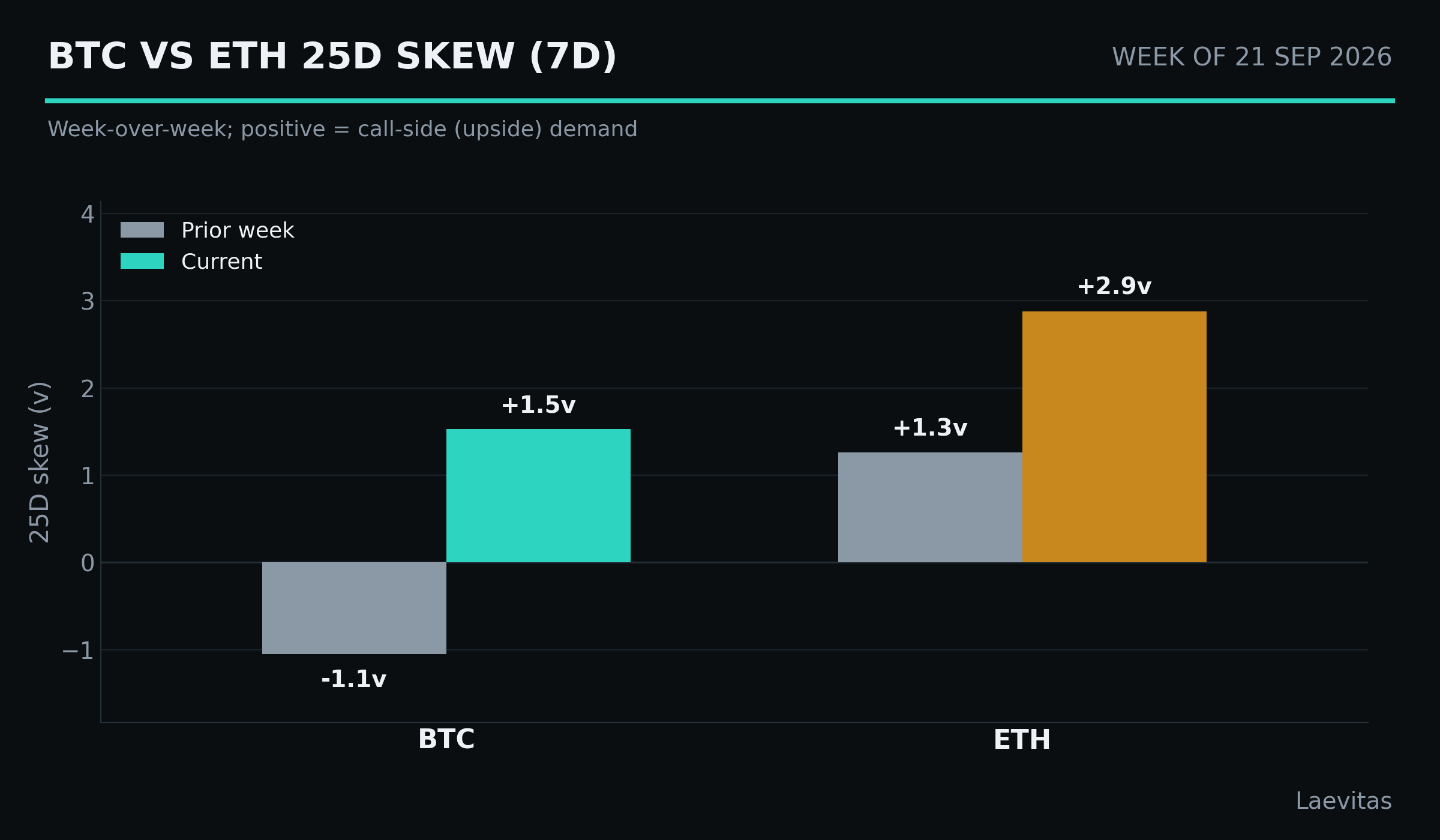
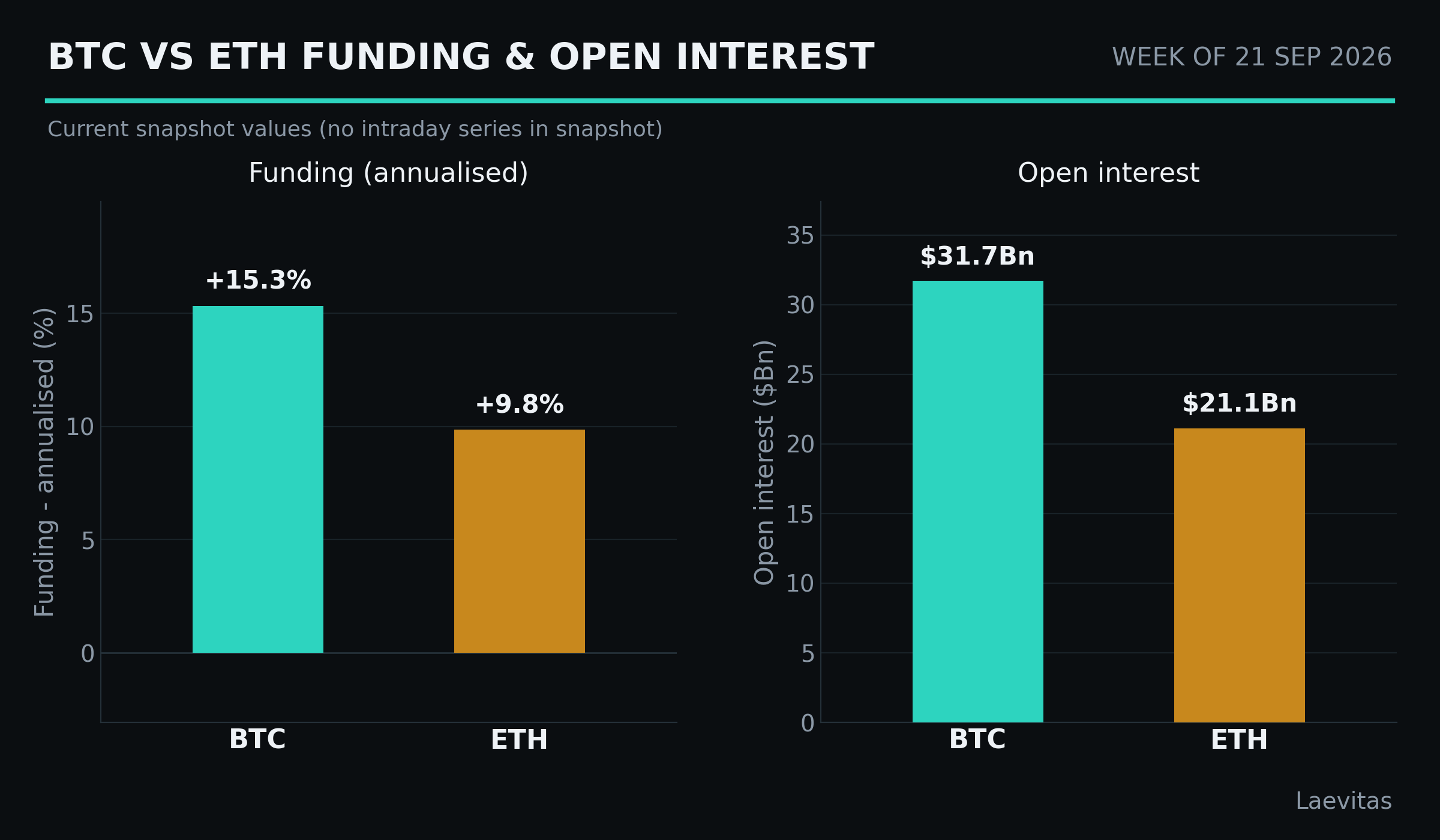
The surface has done the opposite of what the macro overlay would suggest. $BTC 7d 25D skew flipped from -1.05v to +1.53v on the week, a 2.58v move into calls that puts it at the 96th percentile of its 52-week range against a median of -4.42v, and $ETH followed with the 7d from 1.26v to 2.88v and the 30d from -0.60v to 1.37v, both also at the 96th percentile; the $BTC 30d held at -1.39v, itself the 92nd percentile. Calls are richer than puts at the front of both surfaces heading into the $16.6bn Deribit quarterly on Friday, which is a market paying for upside into a Fed that just started hiking, a 10y near 5% and a dollar bid across G10. The perps side is leaning the same way, with $BTC funding up from 5.2% to 15.3% annualised as open interest rose 10.4% to $31,703MM, $ETH funding from 8.5% to 9.8% with OI up 8.9% to $21,115MM, and a $BTC long/short of 0.61 against $ETH at 1.21, a configuration consistent with size on the long side and account count on the short side in $BTC.
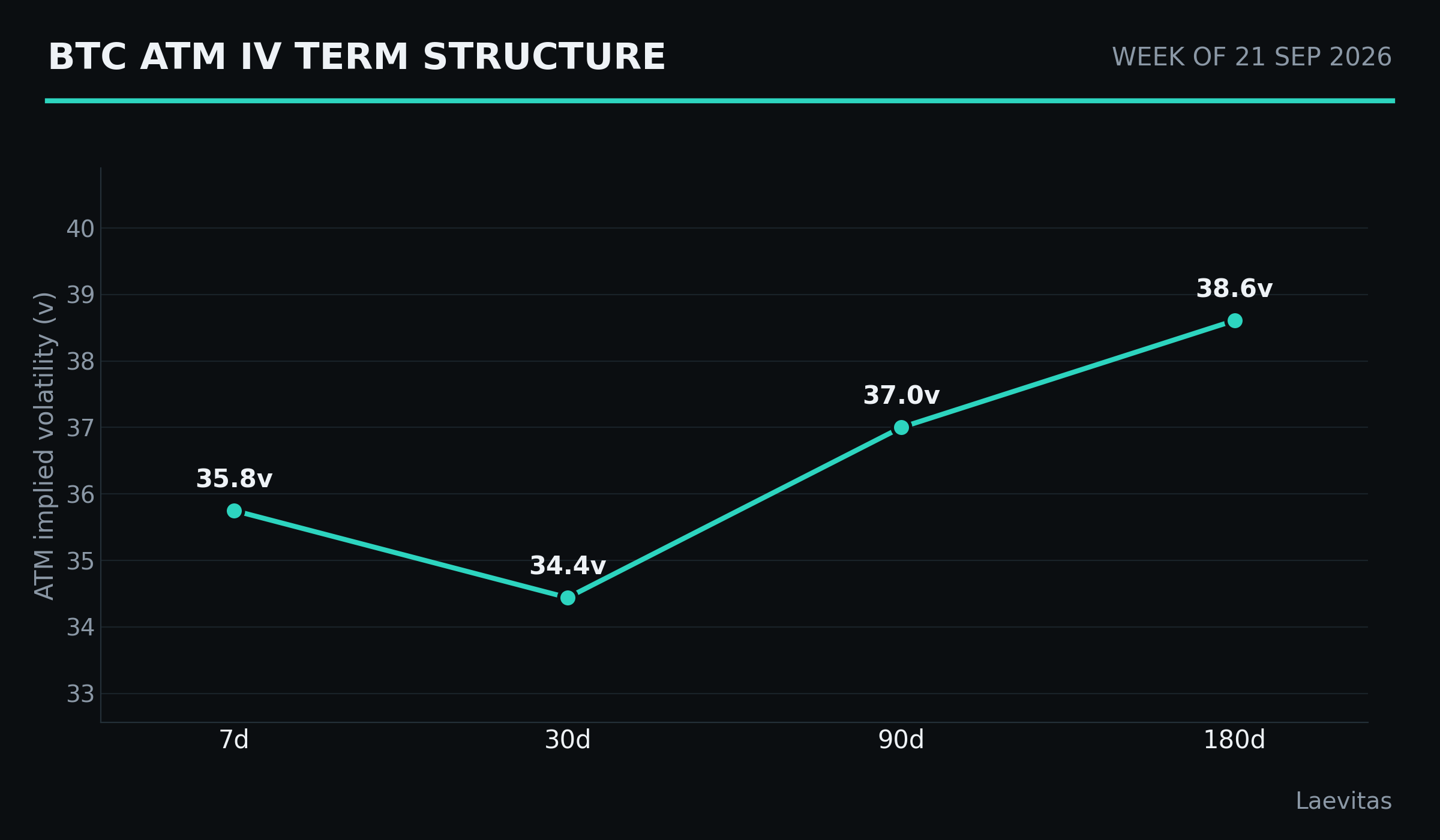
The term structure carries the second observation, which is how quickly the event premium was rebuilt. The $BTC 7d ATM went from 39.3v on the 16th to 28.6v on the 18th as the FOMC premium came out, and has since climbed back to 35.75v with the quarterly expiry now inside the 7d window, leaving the front kinked with 7d at 35.75v over 30d at 34.44v and the curve rising to 37.00v at 90d and 38.61v at 180d. $ETH shows the same shape with less kink, 49.70v at 7d over 49.40v at 30d, then 52.73v at 90d and 54.58v at 180d. On the IV-RV construction, $BTC 7d realised is 35.6v against 36.2v implied and 30d realised 35.1v over 34.4v implied, so the belly is being carried at a small realised premium and the front is priced roughly at fair; $ETH 7d realised 45.2v against 49.0v implied is the widest gap on either surface, a 3.8v spread that flipped positive from the prior week, with the 30d at 48.6v realised against 49.2v implied. Butterflies are modest at 1.45v/0.71v on $BTC and 1.65v/1.50v on $ETH, so wings are cheap relative to the direction the skew is expressing, and with the data slate light the week’s vol catalysts are Fed communication, Tuesday’s Gulf meeting for oil and Friday’s expiry.
The tension for the week is a derivatives market paying up for upside while the macro configuration argues the other way. A skew at the 96th percentile of its year, $BTC funding at 15.3% and OI up double digits into a quarterly expiry is a positioning build that needs the risk-on read - $BTC as an inflation hedge alongside gold, or simply the continuation of the trend that had it up 3% in the week to 4 Sep as part of a risk-on trio with commodities and EM - to keep being right through a week of Fed speakers whose job is to cement October. The FOMC’s pushback was aimed squarely at the debasement narrative, the same holder base that is all-in on gold is the transmission channel into $BTC, and a crowded, call-skewed, well-funded surface is the configuration that unwinds fastest if that channel opens. The counter is that the yen episode has so far produced nothing like the 2024 deleveraging, the VIX has stayed muted and equity dispersion keeps index vol suppressed, so the macro headwind has yet to find a route into crypto price, and the surface is pricing that absence of a route as if it were durable.
Positioning into the week
- Skew reversion into the quarterly: with $BTC 7d 25D at 1.53v and $ETH at 2.88v, both at the 96th percentile of their 52-week range against medians that sit on the put side, a calls-over-puts surface into Friday’s $16.6bn expiry screens as cheap to fade if this week’s Fed communication hardens the October hike into consensus.
- Funding and OI as the unwind fuse: $BTC funding at 15.3% annualised with OI at $31,703MM and a long/short of 0.61 is size-long and count-short, a configuration where a further dollar leg on renewed oil supply fears or a hawkish Williams keynote forces the larger longs to pay to hold, and the liquidation path runs through them.
- Front-end event premium: $BTC 7d ATM rebuilt from 28.6v to 35.75v inside three sessions with the quarterly now inside the window, so the belly at 34.44v against a front that resets lower once Friday’s expiry passes is where the term structure offers the cleanest carry, provided realised stays near the 35.6v it has run at over 7 days.
- Oil as the exogenous driver: Brent above $108/bbl with the Saudi East-West pipeline shut and European refiners warned off next month’s crude is what holds the 10y near 5% and the Fed on its path, and Tuesday’s Trump meeting with Gulf leaders is the one scheduled event capable of moving that input, on which the entire macro overlay for crypto depends.
- $ETH realised premium: the IV-RV read of 45.2v realised against 49.0v implied at 7d, a 3.8v gap that flipped positive on the week, means $ETH vol is being paid for that has yet to show up, and with the 30d skew also flipping to calls at 1.37v the $ETH surface is the more expensive of the two to be long optionality on; that premium compresses if the quarterly passes without a move.
Week ahead | 2026-09-21 | Derivatives via Laevitas