|
||
|
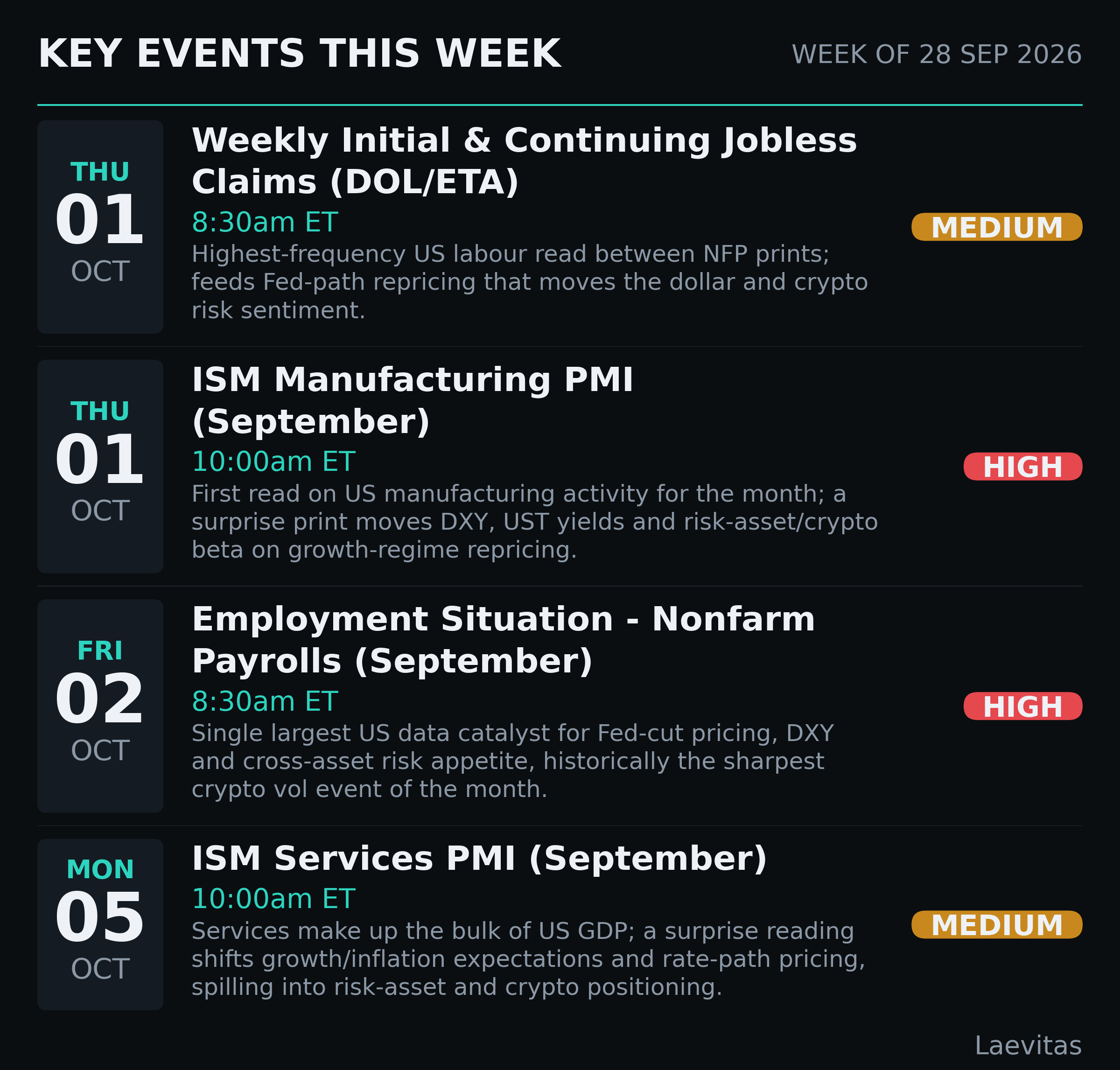
The Monday Brief // 28Sep26Rick @scopicview - Head of Markets, Laevitas The Federal Reserve resolved last week’s flagged pivot in the most hawkish direction available, hiking 25bp to 3.75-4.00% on 17 September with a dot plot whose composition sat above every published forecast, and Chair Warsh used the press conference to make clear the committee would not outsource inflation control to the bond market. That decision landed on top of a live energy shock, and the fortnight since has been governed by Hormuz headlines rather than by the Fed: Brent traded as high as $109.5/bbl intraday around 15 September before slipping below $100/bbl on 22 September as Iran signalled it would negotiate, with a reported US-Iran phased deal to reopen the strait dominating the tape by Friday 25 September. The week ahead hands the market its first tier-1 labour print since the hike, with payrolls on Friday 2 October and ISM manufacturing the day before, into a rates complex where the 30-year has already leaked through 5.5%. Key events this week
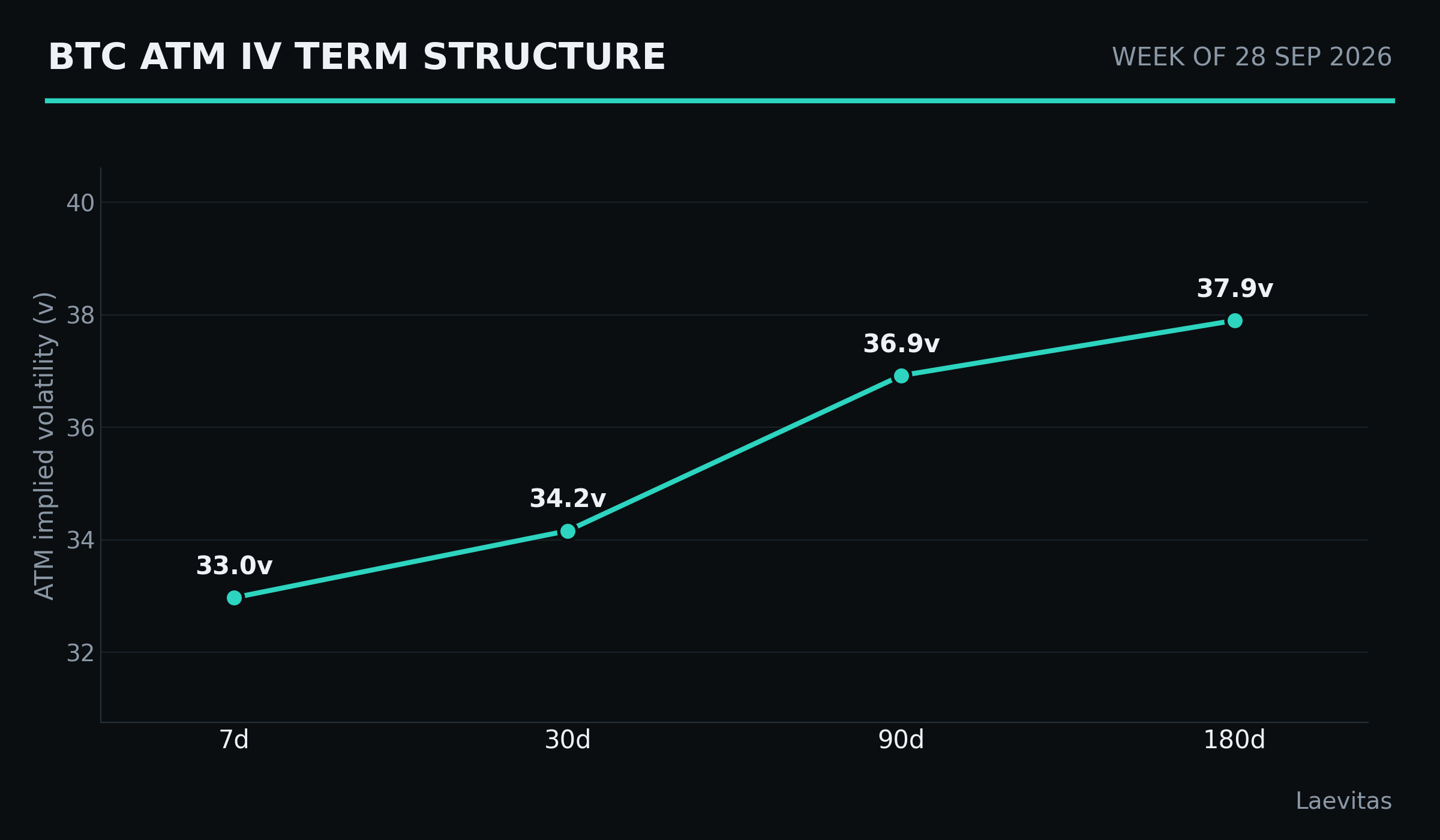
MacroThe uncomfortable arithmetic for anyone carrying crypto beta is that the incoming data is running hot at precisely the moment the Fed has told the market it is willing to act on it. The S&P composite PMI printed 58.4 against 55.3 expected, a five-year high; jobless claims came in at 197k against 201k; new home sales rose 6.4%; and University of Michigan inflation expectations stayed elevated into Friday. Williams called another hike by year-end reasonable and Paulson signalled further modest tightening. Market pricing sits at roughly a coin-flip for October and 75-80% for December, and the honest read of the September dot plot is that hawkish tail risk is still under-priced rather than over-priced - a committee that surprised hawkish once, with wide breadth for two hikes this year and eight projections at 4.25-4.50% for 2027, is unlikely to be talked down by a single soft print. The contrary case rests on the composition of inflation rather than its level, since the underlying components are not obviously reaccelerating and a skip in October costs the Fed nothing given December is already three-quarters priced. The more consequential division sits in the long end, and it separates two theses usually bundled together as constructive for $BTC. The credibility narrative was restored by the hawkish hike; the debasement premium was compressed alongside it, with right-tail vol offered across the complex in the sessions immediately after the presser. Simultaneously, a term-premium repricing is gathering force that has nothing to do with monetary debasement: the 5-year auction tailed 3.1bp and the 7-year 0.7bp, Treasury’s long-end buyback underdelivered twice in succession - $5.187bn accepted of a $6bn maximum, then $4.078bn against a $6bn wallet on $10.468bn offered - Bunds reached their highest yield since mid-2009 and OATs an 18-year high, and the curve bear-steepened Thursday before twist-steepening Friday. Fiscal stress and monetary debasement are different trades with different hedges, and only the first of them is still alive; the weekly buyback operations, one per week for four weeks from 23 September, are the cleanest observable on which of the two is setting the tone. The most consequential tail for crypto deleveraging risk sits in Japan. The BoJ hiked to 1.25%, a three-decade high, but the composition beneath the headline was dovish, with two board members dissenting in favour of a hold and Ueda cautioning against moving too quickly; the yen weakened 1.2% to around 158 before a rate check clawed part of it back. Takaichi has since acknowledged that an undervalued currency is problematic after Trump raised it directly, and the BoJ Summary of Opinions from the 17-18 September meeting lands late Wednesday. A grinding move higher in USDJPY keeps carry funding cheap and the risk backdrop benign, whereas a disorderly squeeze on intervention is the textbook trigger for a crypto unwind, and that asymmetry argues for keeping optionality on rather than harvesting premium into it. CryptoThe vol surface has spent the week giving back the FOMC premium and now prices something close to calm. $BTC 7d ATM IV has collapsed from 37.9v on 22 September to 33.0v, dipping as low as 29.3v on Saturday before a modest bid back into Monday, while the 30d sits at 34.2v, barely changed on the week - the term structure is cleanly upward-sloping from 33.0v at 7d through 34.2v, 36.9v at 90d and 37.9v at 180d, with no inversion anywhere in the curve. $ETH carries the same shape at a higher level, 43.1v at 7d rising to 47.4v and 51.9v, after 49.7v at 7d a week ago. The realised comparison is where the two assets diverge: on the IV-RV construction $BTC shows 7d realised 34.6v against 32.8v implied, a negative 1.8v spread that puts gamma marginally cheap relative to what spot has actually been delivering, while $ETH shows 7d realised 37.3v against 43.2v implied, a positive 6.0v spread. A 7d curve at 33.0v with payrolls and ISM manufacturing inside the window, and a Hormuz binary that has already produced double-digit dollar swings in Brent, is a thin premium for the event set.
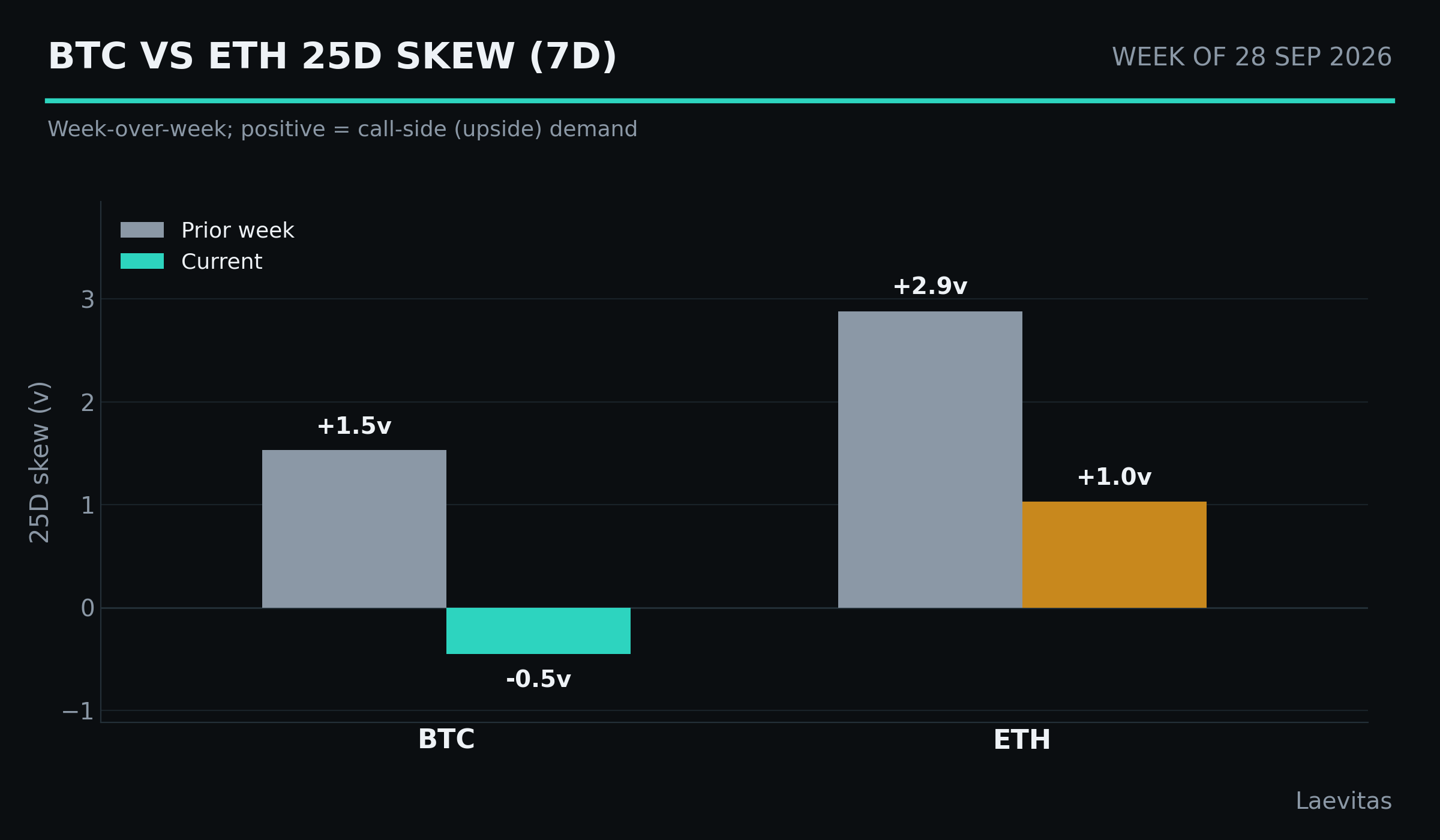
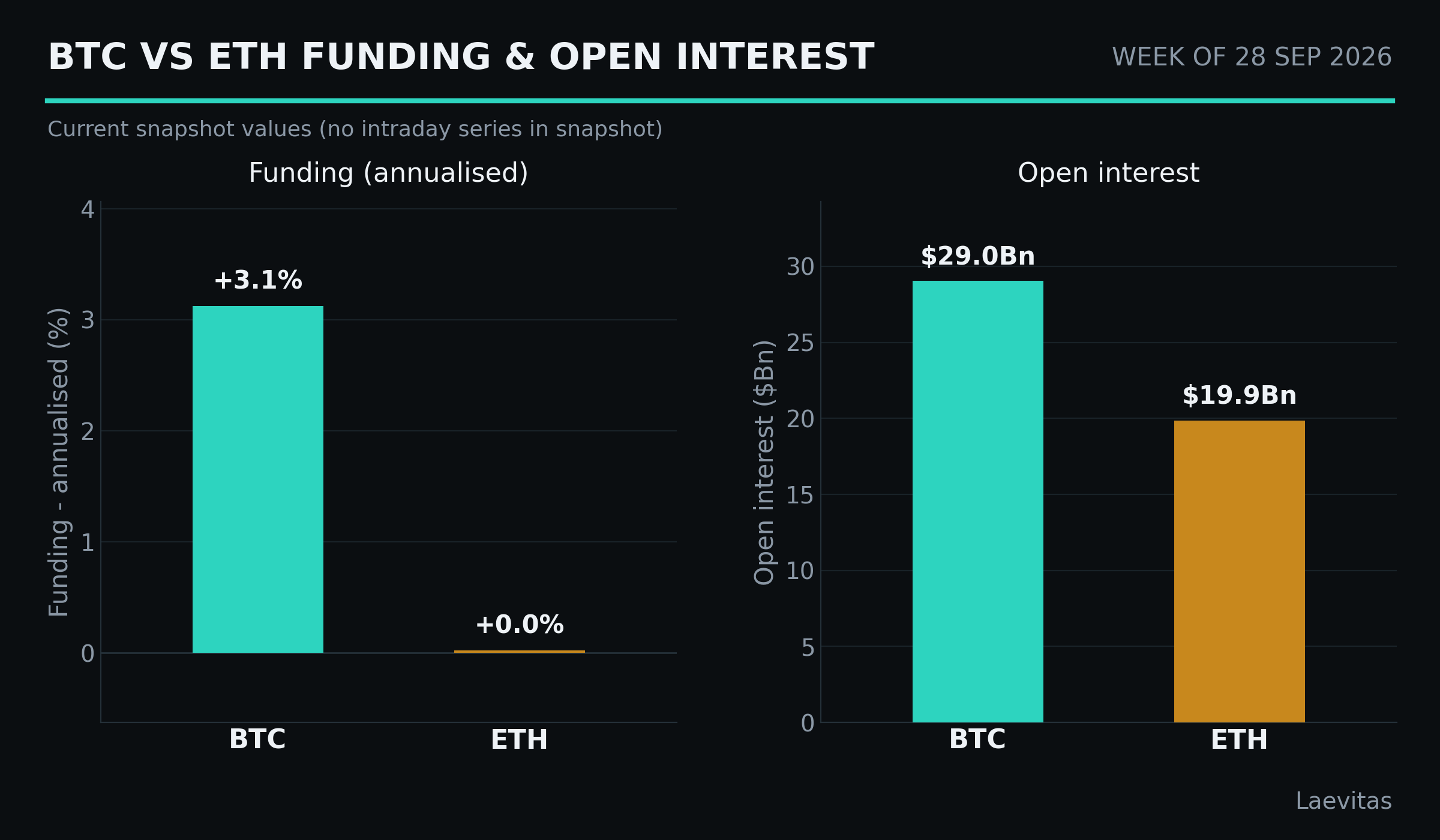
Skew moved more than any other leg of the surface this week, and its direction is easily misread. $BTC 7d 25D skew has swung from +1.53v to -0.45v, a 1.98v week-over-week shift, and $ETH 7d from +2.88v to +1.03v, a 1.85v move, with the 30d legs split - $BTC firmer at -0.77v and $ETH down to a flat -0.13v. What looks like a put bid appearing is reversion from a call-bid extreme, since both assets sit around the 92nd percentile of their 52-week distributions against medians of -4.41v on $BTC 7d and -3.78v on $ETH 7d; calls are simply less bid than they were, and puts remain historically cheap in relative terms. Perp positioning tells the same de-risking story: $BTC funding has fallen from 15.3% to 3.1% annualised and $ETH from 9.8% to effectively zero, with open interest down 8.4% to $29,034MM on $BTC and 5.9% to $19,859MM on $ETH, while the $BTC long/short ratio at 0.81 against $ETH at 1.48 marks a genuine split in how the two books are positioned. Both leverage and the vol premium have been taken out of the market, while the event calendar ahead is unchanged.
The tension for the week is whether a market that has just stripped out its event premium is right that the binaries resolve benign. Three of them land inside five sessions - payrolls into a committee that has explicitly cited a strengthening backdrop, ISM manufacturing into a composite PMI already at a five-year high, and a Hormuz deal that is reported rather than concluded - and the vol surface has compressed 7d $BTC implied from 37.9v to 33.0v into them. Being short gamma into that set is expensive on current pricing, while owning the wing costs comparatively little, particularly on $BTC where realised is running above implied on the IV-RV read and downside strikes remain cheap against their 52-week median, even after puts have richened against calls since last Monday. Against that, the de-escalation path is genuinely live, theta is the whole cost of being early, and a compressing vol surface with leverage already flushed is not a configuration that produces a disorderly move on its own; it requires a catalyst, and this week supplies three candidates. Positioning into the week
Week ahead | 2026-09-28 | Derivatives via Laevitas |
||
|
You are receiving this because you subscribed to the Crypto Derivatives Briefs at laevitas.ch. Laevitas SA, Switzerland. Unsubscribe · Privacy |