

The Monday Brief // 19Oct26
Rick @scopicview - Head of Markets, Laevitas
Last week’s flagged pivot was whether the September inflation print would drag the October meeting back towards a coin flip; that question resolved in favour of the skip, with the Fed chair describing economic conditions on 16 October as broadly in line with the September meeting’s own expectations shortly before the blackout closed around the 27-28 October decision. What carries into this week is a long-end-led rates move layered onto an oil tape that has already traded to $110/bbl and retreated, plus an Asian tech complex wobbling on AI capital-spending concerns. The crypto vol surface has absorbed all of that with a composure which looks increasingly difficult to justify.
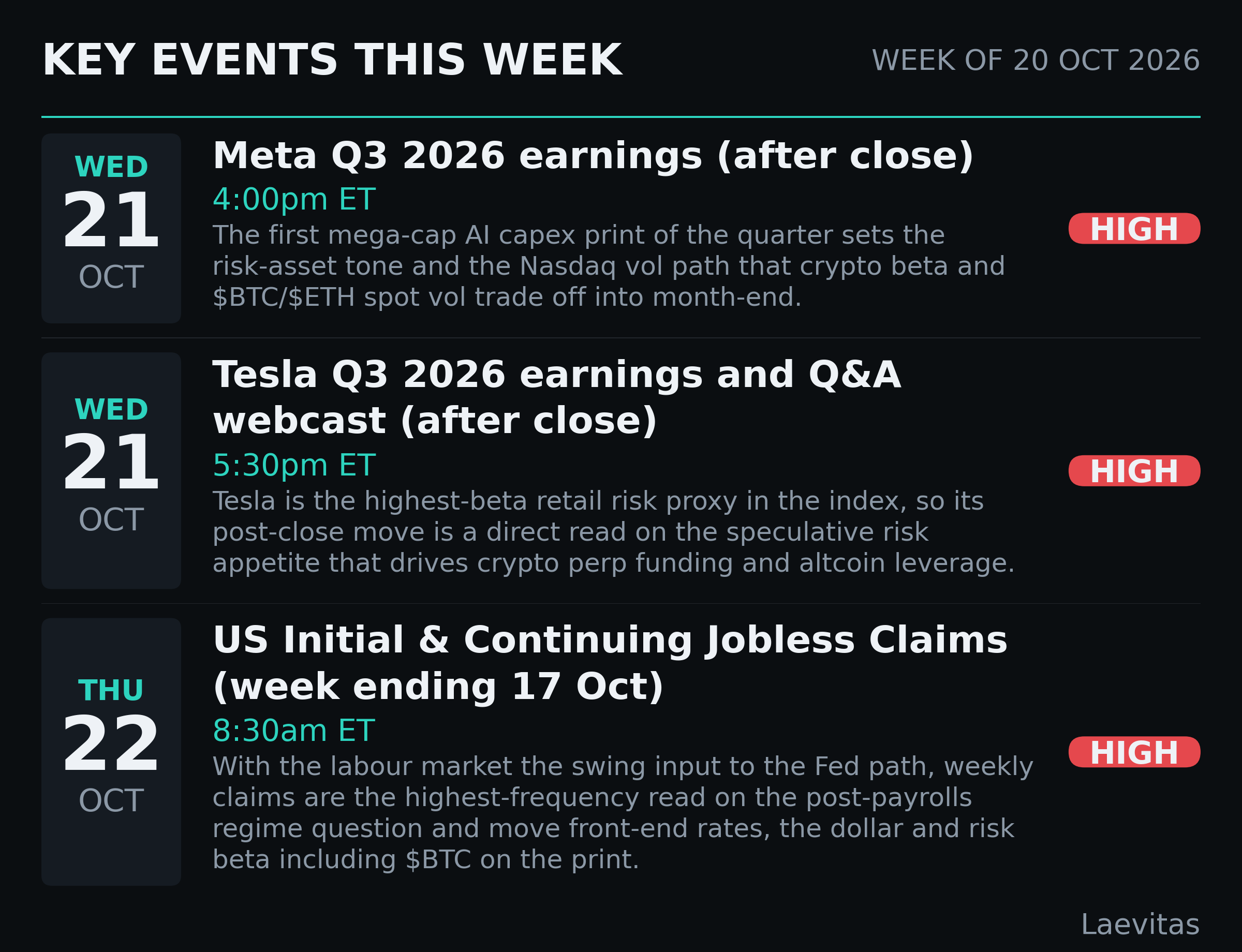
Key events this week
Macro
The regime anchor deserves restating, because most crypto positioning still reads the backdrop as a cutting cycle when the front end has roughly 100bp of hikes already in it and December was priced near 85% at the start of the month, a level that looked stretched then and offers poor compensation for anyone paying it now. The more interesting development is the change in character of the selloff, from a front-end-led bear flattener driven by geopolitics and hawkish rhetoric into a long-end-led bear steepener driven by term premium, with little improvement in the fiscal outlook, persistent supply and a thinning pool of incremental buyers doing the work. Longer-dated forwards screening some 40-50bp above any plausible fair value, against a front end already pricing hawkish relative to the data, says the marginal yield move is a risk-premium story; the observation from the Fed that higher back-end yields are themselves doing some of the work of tighter policy is an acknowledgement that the long end has become the transmission channel. Risk appetite here is gated by the volatility of rates, which is why psychological thresholds in yields are a poor guide to when duration demand returns.
The oil thread is the one that should change how a crypto book is hedged. Tanker attacks in the Strait of Hormuz and rising Yemen tensions took Brent above $102 in the first full week of October, followed by a $5/bbl overnight rally, and by 19 October the tape had been to $110/bbl before retreating 1.5% as an executive order waiving some Russia sanctions and tariffs opened a supply-relief channel. Duration’s sensitivity to oil has become asymmetric, having lost much of its positive beta on moves lower while retaining meaningful downside beta when oil rallies, and the implication for a long crypto book is uncomfortable, since an oil-driven risk-off raises yields, compresses risk appetite, and leaves the Treasury hedge failing in precisely the direction where it is needed. The political gate on escalation is real, though it operates on the timing of Iranian action while leaving the physical capacity untouched, and the reported existence of US strike plans for Iranian energy and nuclear infrastructure either side of the midterms, alongside Iran fortifying sites for a post-midterm resumption, argues the tail is live while the modal path remains headline-driven chop.
Europe supplies the second tail and it widened again at the start of this week, with civil unrest in France pushing the 10y OAT-Bund spread 6bps wider to 145bps and no expectation of near-term official intervention to arrest it. Alongside higher Italian deficit projections and an imminent Spanish election, the year-end funding turn becomes the moment this matters for crypto, since dollar funding stress is the historical transmission channel into liquidations and basis dislocation. Asia adds a third strand, with the Korean complex suffering its worst session in three months in mid-October as AI capital-spending concerns took hold, two days after a chip-led drop on a Chinese memory-chip breakthrough claim and an industry warning about overheated sentiment, which makes the two mega-cap prints on Wednesday after the close the week’s genuine test of whether the AI capex narrative still supports equity risk appetite. Equities have so far shrugged off the turbulence in rates, and that divergence should hold for as long as the risk-on bid does, narrowing if the long end keeps cheapening into the FOMC. The Bank of Japan leaning against a back-to-back hike this month removes one source of near-term cross-market vol, leaving the dollar leg of the European story as the cleaner expression.
Crypto
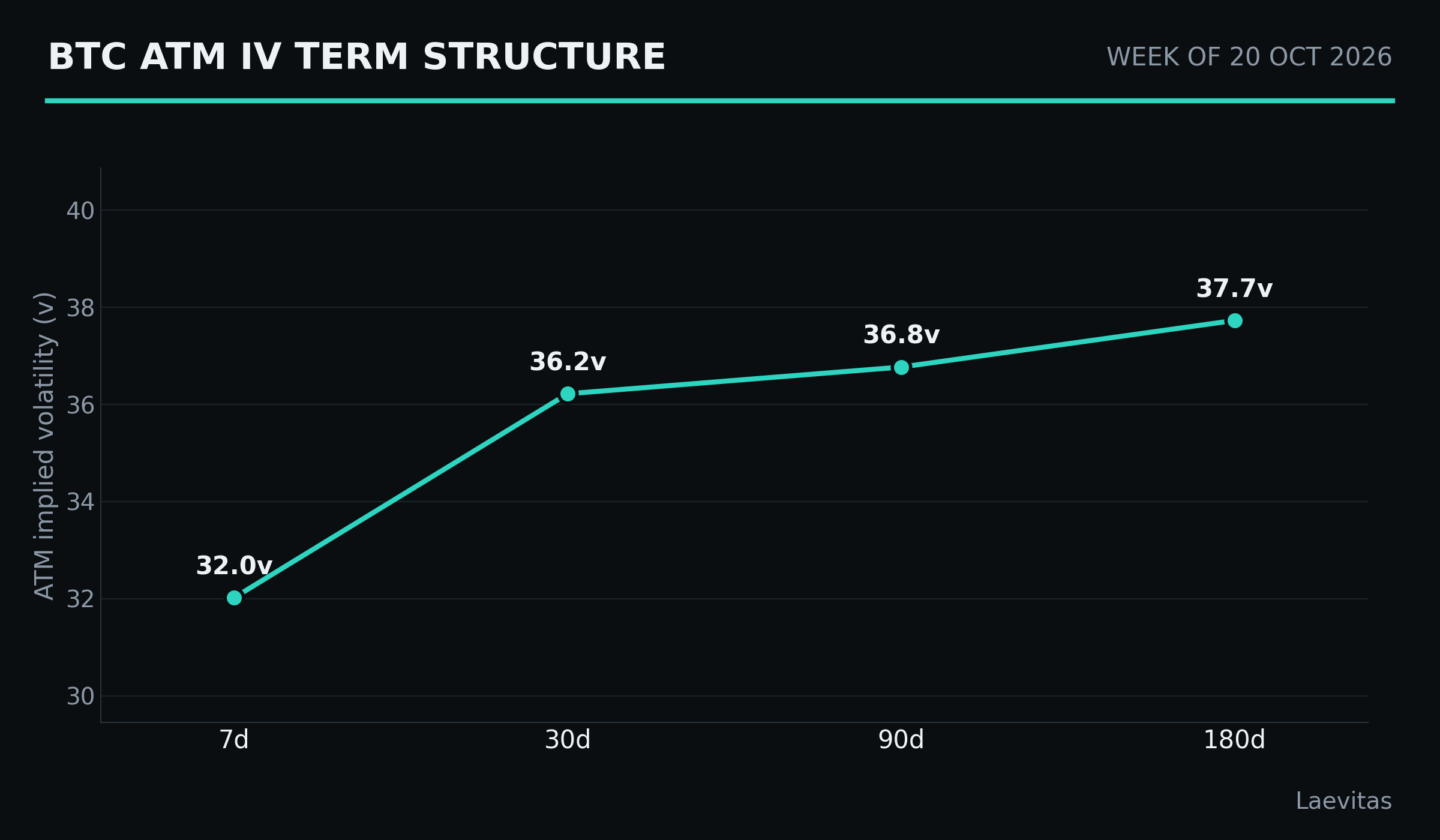
The $BTC term structure is upward sloping across its full length at 32.0v in 7d, 36.2v in 30d, 36.8v in 90d and 37.7v in 180d, with no inversion anywhere and a front end that is unchanged week-over-week after dipping to 30.5v on 17 October. That flat front end sits awkwardly against the realised-premium read: 7d realised 34.1v against 31.4v implied on the IV-RV construction, and $ETH 50.0v over 45.9v, so short-dated optionality is being marked below what the tape has actually delivered. The 30d leg tells the other half of the story, with implied holding a premium of 36.2v over 32.4v realised for $BTC and 49.2v over 41.8v for $ETH on the same construction, which is the surface putting its event premium in the tenor that captures the FOMC. $ETH’s own front end is where the money moved, ripping from 41.7v to 46.6v in a week while $BTC’s held at 32.0v, widening the cross-asset vol spread into a period when the higher-beta leg carries both the equity-capex sensitivity and its own protocol calendar.
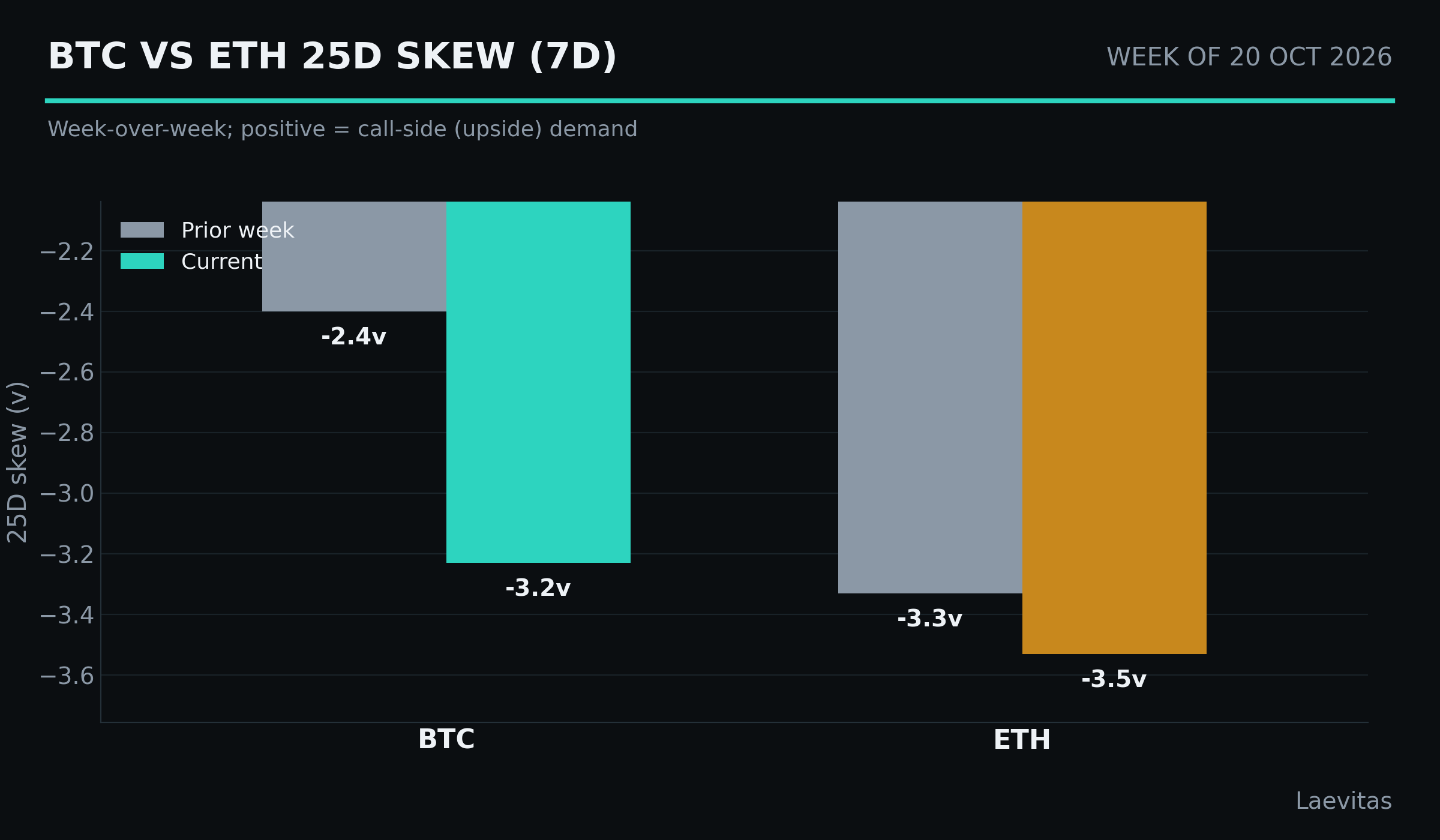
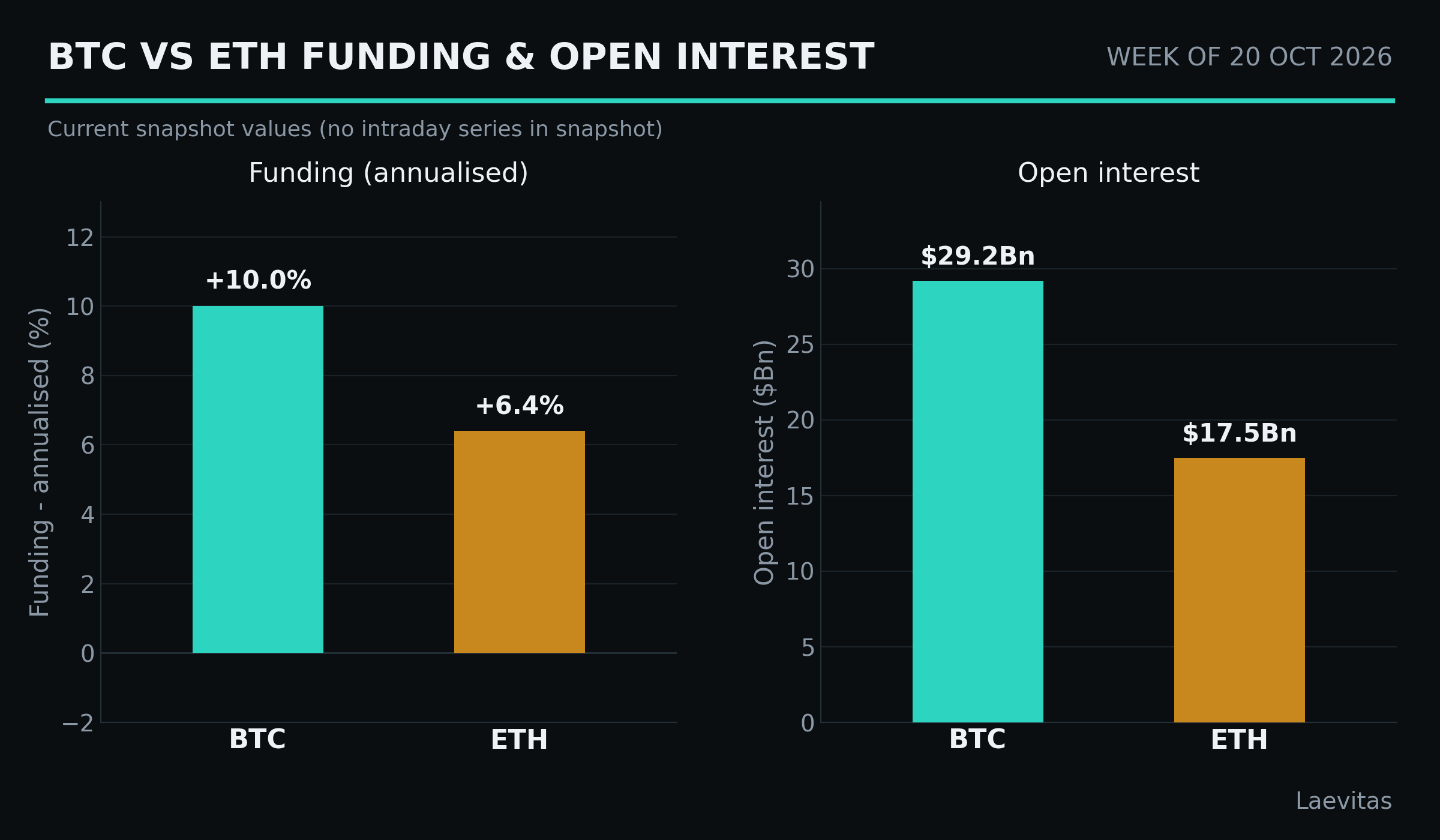
Skew has drifted steadily towards puts without reaching anything resembling hedging demand. The $BTC 30d 25D skew moved from -2.22v to -3.31v and the 7d from -2.40v to -3.23v, yet both remain less put-bid than their own 52-week medians of -4.63v and -4.20v, leaving the 30d at the 74th percentile of its year, so the week’s move unwinds a position that sat at the least put-bid end of its range, with room still to travel before protection screens as genuinely well-owned. $ETH tracks the same path from -1.92v to -2.53v in 30d. Butterflies are compressed at 0.72v for $BTC 30d and 1.26v for $ETH, so the wings are priced close to the body in a week whose dominant risks are gap-shaped. In perps, funding has firmed from 5.6% to 10.0% annualised in $BTC and from 4.2% to 6.4% in $ETH, while open interest has moved differently across the two, with $BTC broadly flat at $29,176MM, down 0.5%, and $ETH down 8.0% to $17,479MM. A long/short ratio of 1.78 in $ETH against 1.04 in $BTC describes a thinner $ETH book carrying the same directional tilt into Friday’s Deribit weekly expiry, with the Hoodi testnet fork the following week as the protocol-specific date.
The two tenors are pricing different weeks, which accounts for the awkwardness in the surface. The 7d expires before the FOMC convenes, so the front end is pricing a week whose scheduled macro amounts to jobless claims on Thursday and two mega-cap earnings prints, while the 30d carries the decision and holds its premium over realised for that reason. The market is treating the October skip as settled and December as close to done, which concentrates what risk remains in the tone of the statement itself, since a hawkish adjustment would have to be repriced against a path already taken as given, and leaves crypto taking its cue from a long end where term premium is still building. Set against that, short-dated $BTC vol at 32.0v is delivering 34.1v, the 30d butterfly at 0.72v prices the wings close to the body, and the oil tail remains live. Optionality is therefore cheap relative to what the tape has been delivering, at a point where the Treasury hedge has stopped working in the direction a long crypto book needs it.
Positioning into the week
- Short-dated $BTC optionality against delivered vol: the 7d tenor at 32.0v sits beneath 34.1v realised on the IV-RV read, a gap that persists while a headline-gated tape keeps delivering intraday range without establishing trend.
- Cheap wings as the geopolitical expression: the $BTC 30d butterfly at 0.72v and $ETH at 1.26v price the tails close to the body, which is the structure that pays if the oil tail transmits into yields in the one direction where duration beta turns against a long crypto book.
- $ETH vol over $BTC vol: the 7d leg ripped from 41.7v to 46.6v while $BTC’s front end held unchanged at 32.0v, and that spread widens further should the AI capital-spending wobble in equities keep the higher-beta leg moving through Wednesday’s prints.
- Skew unwinding from the least put-bid end of its range: 30d $BTC at -3.31v remains less put-bid than its 52-week median of -4.63v at the 74th percentile, so the week’s drift reflects positioning being unwound, with scope to extend towards the median before downside protection looks crowded.
- $ETH perp de-grossing into a long-tilted book: open interest down 8.0% to $17,479MM with funding firming to 6.4% annualised and the long/short ratio at 1.78 describes a thinner book carrying an unchanged directional lean, which amplifies any cascade around Friday’s expiry.
Week ahead | 2026-10-19 | Derivatives via Laevitas