

The Monday Brief // 26Oct26
Rick @scopicview - Head of Markets, Laevitas
Last week’s flagged pivot was the September inflation complex, and it resolved hawkish: core CPI came in above expectations at +0.33% m/m with PPI confirming the following day, enough to drag terminal-rate expectations higher and to put a five-month high in Brent on top of it. That hot print now runs straight into a 72-hour window containing the FOMC, the ECB and the BoJ, with September core PCE landing the morning after the Fed. The cross-asset tape has already turned: the 10y OAT-Bund spread gapped to 178bp, its widest since 2011, Treasuries caught their first genuine flight-to-quality bid since the Iran escalation began, and $BTC traded -4.1% in the 22 October session, falling alongside gold and silver.
Key events this week
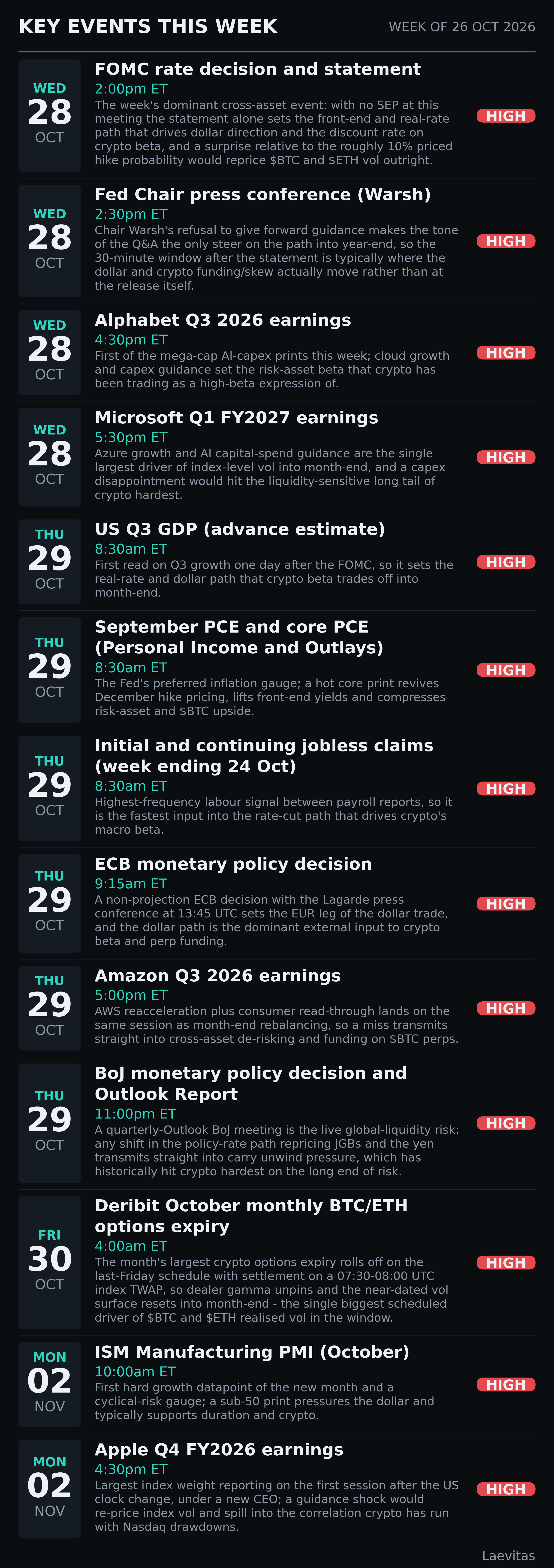
Macro
The energy leg is the binding constraint and it is not behaving like a transitory shock. Brent has pushed through $114/bbl on intensifying Houthi strikes against Saudi infrastructure, up from a trough near $79 in early August, and the persistence is visible along the curve and not just in the front contract - Dec'27 futures have been making fresh highs above $85/bbl while spot merely stabilised, which is a market pricing a structural supply premium into the curve. The refined-products chain is worse than crude: diesel at year-to-date highs above $1,460, European gas inventories heading into winter at the lowest level in fourteen years with TTF above 86 EUR/MWh. Upstream pass-through is already unambiguous - China’s PPI accelerated to 5.0% y/y with oil and gas extraction at 24.5%, and euro area October flash manufacturing input prices hit 74.9, the fastest since May - while output prices actually decelerated to 55.5. That gap is margin compression, and the disinflation story now depends on how long margins can keep absorbing it. If the oil shock proves permanent instead of decaying, input-output estimates put roughly 20bp of core CPI on each 10% move in crude against the 3-5bp the dynamic models assume.
The consequence matters more for crypto positioning than the oil price itself. Three G3 central banks meet inside 72 hours and the configuration argues for all three holding while signalling further tightening ahead - hold at 3.75-4.00% with hawkish dissents in the US, a slightly dovish hold in Frankfurt with a final hike pencilled for December, and a hold at 1.25% in Tokyo alongside a declaration that underlying inflation is now consistent with the 2% target. Market pricing for an October Fed hike has collapsed from an intraday spike above 50% on the CPI release to around 7%, so it is the communication that carries the risk here, from a chair who has consistently refused to pre-judge meetings, six days before the midterms, with AI-driven demand explicitly flagged as a near-term inflation source. This is a stagflationary squeeze without a dovish escape hatch, and the assumption most crypto narratives default to - that a risk-asset drawdown buys central-bank easing - has nothing supporting it in the current configuration. Real policy rates remain elevated, terminal pricing sits around 4.5-4.7%, and no G3 bank is cutting.
The positioning backdrop is genuinely bimodal and that is the hardest part to hold alongside the directional read. US long/short net leverage fell 3.2 points to the 0th percentile of five years, the largest weekly drop since April’s tariff episode; hedge funds have reversed all cumulative net buying of global AI equities since the start of 2025; CTAs at $39bn of length are modelled to turn buyers on both one-week and one-month horizons. Against that, the mechanical index sell trigger sat only 0.5% below spot as of 23 October with flat-market selling quintupled to $48bn, dealer gamma collapsed from the 99th percentile on 15 October to the 41st by 22 October, and realised vol has refused to confirm any of it - five-day S&P intraday realised at 11.2%, the 36th percentile of the year, through a 1.21% selloff with VIX near 20. With no dealer pin holding the middle and net exposure washed out, both tails are expensive to own against a distribution weighted to the centre. Crypto-specific flows run the same way, with $0.2bn into crypto funds last week against $55.6bn into equities and $18.8bn into tech and $BTC at -7.1% year-to-date.
Crypto
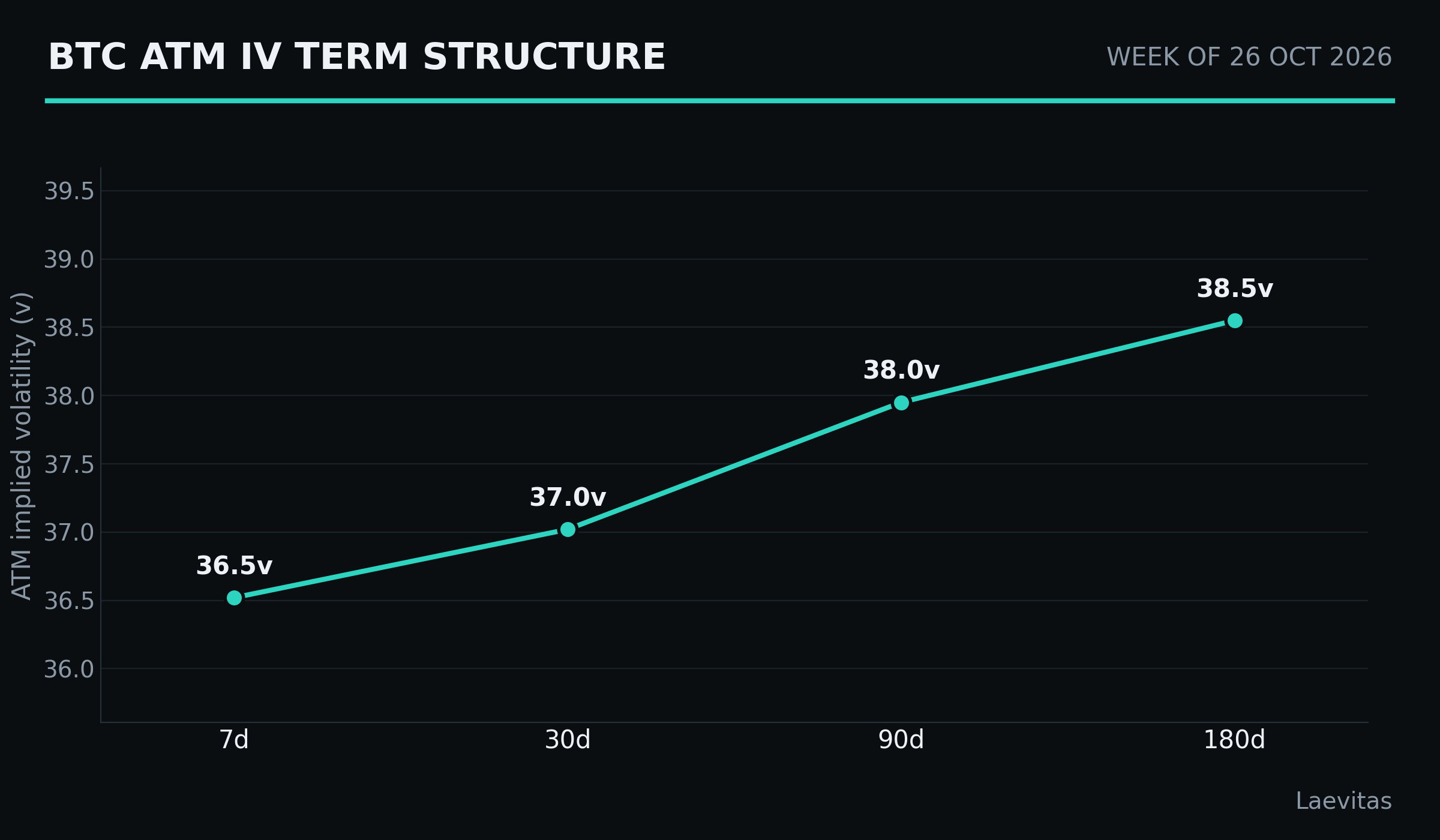
The vol surface has repriced hard at the front, and the scale of the week-over-week move matters more here than the level it has settled at. $BTC 7d ATM IV jumped from 32.0v a week ago to 36.52v, having traded as low as 29.8v on 22 October; $ETH 7d went 46.6v to 52.11v over the same stretch. That bid has flattened the $BTC curve to something close to flat - 36.52v at 7d against 37.02v at 30d, 37.95v at 90d and 38.55v at 180d - which is the front end pricing the FOMC, the ECB, the BoJ, core PCE, Q3 GDP and four mega-cap earnings reports inside five sessions, with the Deribit October monthly expiry landing on the Friday. $ETH has gone further and is now genuinely inverted at the front, 52.11v at 7d over 50.86v at 30d, with the 90d back up at 52.13v - a kink that only exists when a dated event cluster is being paid for directly. Realised has not kept pace with any of it: on the IV-RV construction $BTC shows 7d realised 26.9v against 36.1v implied and $ETH 40.6v against 51.8v, a 9.2v and 11.2v premium respectively, and both spreads flipped from negative a week ago, so the front-end optionality is being bought well ahead of the events themselves.
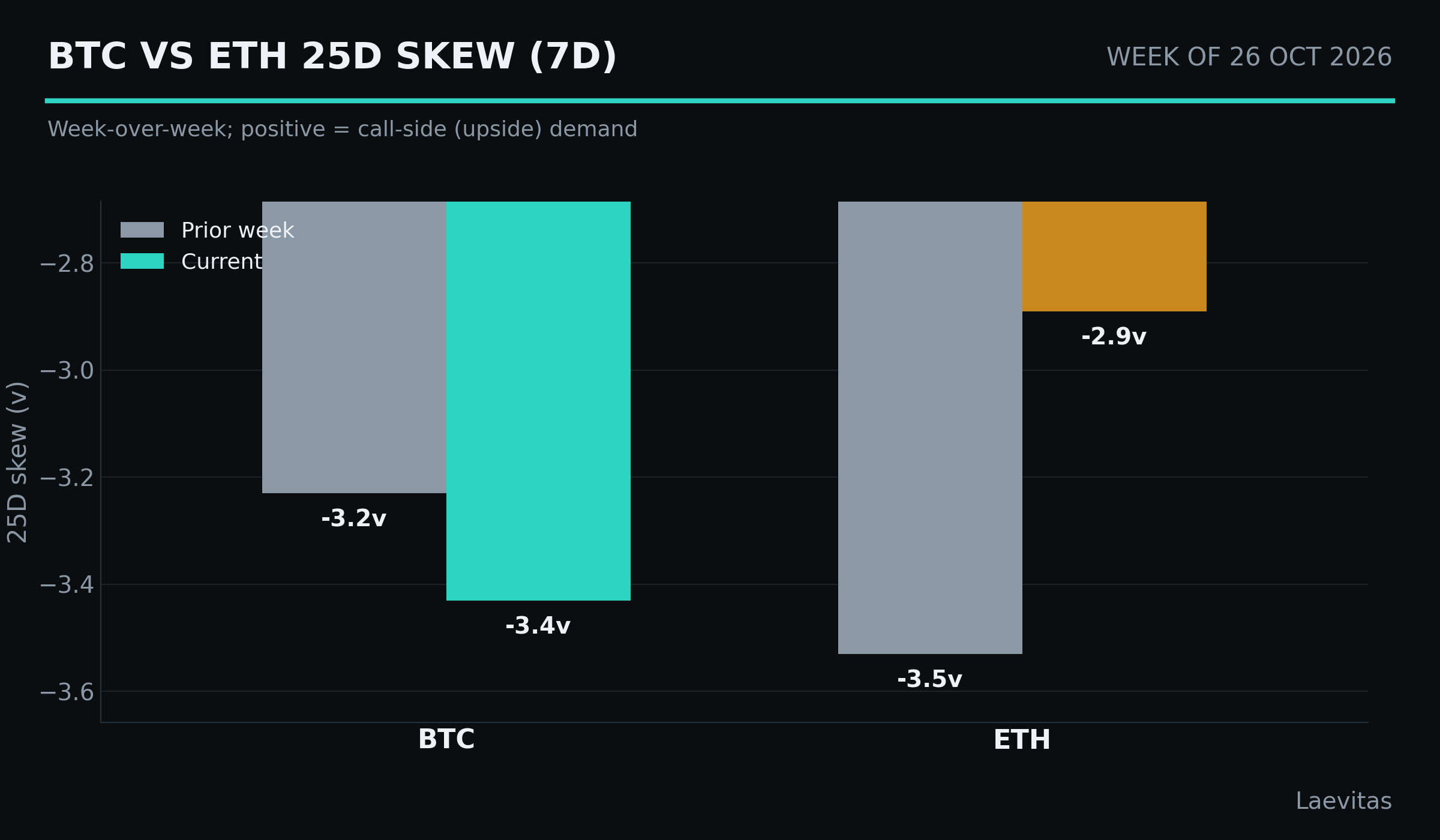
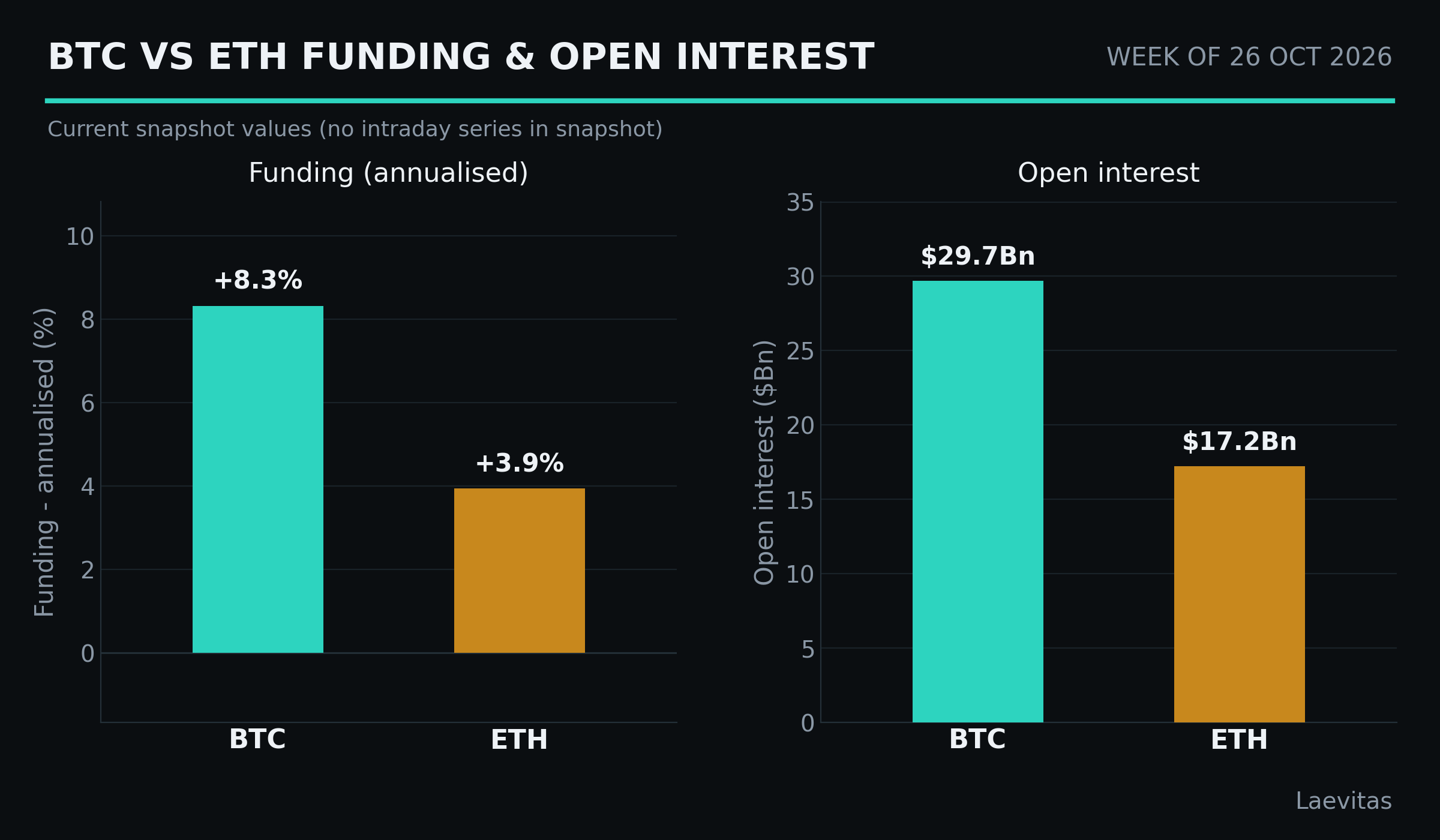
Skew is where the week-over-week move changes the reading most. $BTC 30d 25D skew moved from -3.31v to -4.64v, a 1.33v shift to the put side in seven sessions, and now sits at the 49th percentile of its 52-week range against a median of -4.62v - which places it almost exactly mid-distribution, nowhere near a hedging extreme. The 7d tenor at -3.43v, from -3.23v, remains less put-bid than its own 52w median of -4.18v, so the front-end move reads as reversion from the least put-bid end of the range, with no sign of fresh demand for downside protection. $ETH splits across tenors: 7d actually moved towards calls, -3.53v to -2.89v, while 30d went -2.53v to -3.38v. Perp positioning corroborates the drift - $BTC funding has eased from 10.0% to 8.3% annualised with open interest up 1.7% WoW to $29,680MM, while $ETH funding fell by close to 40%, from 6.4% to 3.9%, with open interest down 1.5% to $17,211MM, and an $ETH long/short ratio of 1.98 against $BTC’s 1.27 marks where the crowded side still sits.
The tension for the week is that the vol surface is paying for event risk in a market whose realised volatility keeps declining to confirm it, and the events themselves are more likely to deliver communication than action. An FOMC priced at roughly 7% for a hike, an ECB at around 1% and a BoJ at 3% are decisions whose accompanying language carries the entire payoff, with little positioning against the outcomes themselves, and a 9.2v $BTC premium at 7d is expensive compensation for a hawkish hold that merely restates what two hot inflation prints already established. A dollar-negative surprise is what screens cheap here, and almost nobody is paying for it: into a market where investors sit at +7.2/10 long USD with every segment on the same side, it is the single scenario that mechanically helps this asset class, and it is being priced as a tail. Against that, if margin absorption breaks and the energy pass-through accelerates, the front-end rates view, the gradualist-Fed premise and crypto beta all fail together in the same direction - these are not independent exposures, and core PCE on Thursday is the first scheduled test.
Positioning into the week
- $ETH front-end inversion as the cleanest event-risk expression: 52.11v at 7d over 50.86v at 30d is the surface paying explicitly for the five-session event cluster, and the kink flattens mechanically once the BoJ clears on Friday morning unless the Deribit monthly expiry pins spot into a corner.
- $BTC 7d realised premium screens rich: 26.9v realised against 36.1v implied on the IV-RV read is a 9.2v spread carrying a hawkish-hold outcome that two inflation prints have already signalled, and it compresses if the communication lands as expected.
- 30d $BTC skew sits mid-distribution: the 1.33v week-over-week drift to -4.64v sits at the 49th percentile against a -4.62v median, so the configuration offers no evidence of crowded downside protection and leaves put structures priced close to fair.
- The crowded dollar long is the asymmetric crypto input: investor positioning at +7.2/10 with all segments on the same side means a dollar-negative surprise is the higher-impact tail, and it is the only scenario in the current macro configuration that mechanically supports this asset class.
- Funding decay against rising implied vol marks a market unwilling to carry spot risk: $BTC at 8.3% annualised and $ETH down to 3.9% while front-end IV repriced five points higher describes positioning expressed through options instead of leverage, which removes the liquidation fuel a directional break would normally find.
Week ahead | 2026-10-26 | Derivatives via Laevitas