
The Monday Brief // 02Nov26
Last week’s pivot resolved quietly: a hike was effectively off the table going into the 28 October decision given the dovish turn in Fed commentary since September, the proximity of the midterms and the growing downside risk around AI capex, and a December move stayed largely priced through it, so the question of how a hold squares with the messaging after a hot CPI print was deferred and never settled. The Bank of Japan then held eight-to-one on 30 October with Governor Ueda repeating a proactive stance and the claim that every meeting is live, the RBNZ surprised with a hold against close to 25bp priced, and Brent pushed through another five-month high to $118/bbl into month-end while equity futures, credit and the dollar all gave ground. Firm energy, soft mega-cap tech earnings and a rates market rallying into a week that carries the US midterms, the quarterly refunding announcement and payrolls is the thread that matters for crypto this week.
Key events this week
Macro
Energy is doing the work in the inflation channel and it moved both ways last week. Brent sat at $115/bbl midweek on reporting that Gulf states had been told to prepare for a short, intense military campaign after the midterms, slipped to $114/bbl as outreach to Iran and Iranian signals that diplomacy still had a chance took the premium back out, then broke to $118/bbl into Friday’s month-end fix, a fresh five-month high. A crude price making new highs on a two-way diplomatic headline flow is the most awkward input a central bank facing an already-hot core print can have, and it is the mechanism by which a December hike stays priced even as equity risk deteriorates. The implication for a crypto book is specific and uncomfortable: a risk-asset drawdown driven by an energy-led inflation impulse does not purchase policy relief, so any rally narrated as the end of the tightening cycle is unsupported by what the rates market is actually pricing.
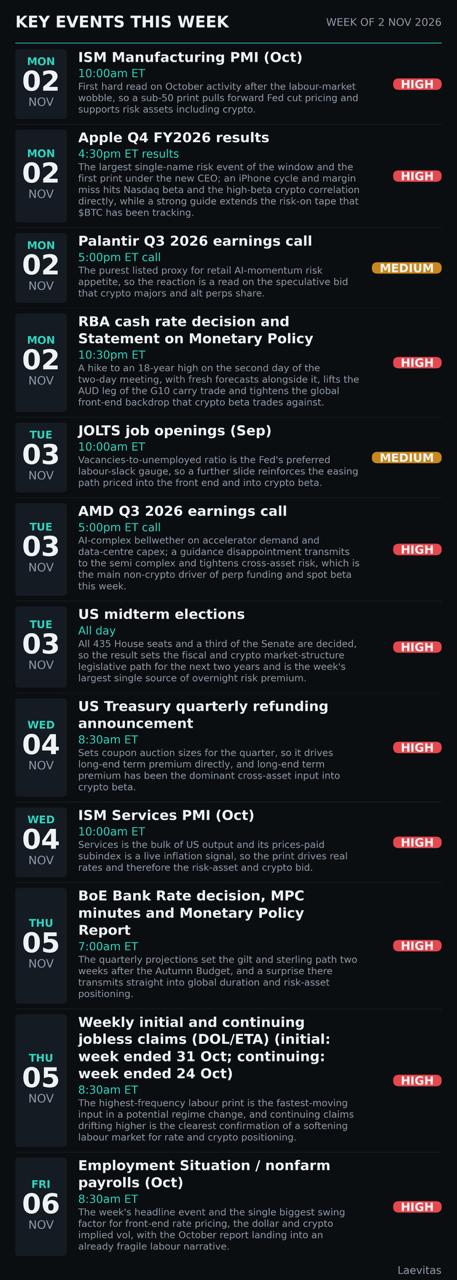
The policy configuration into this week is hold-and-signal-more across the board. The RBA decides late Monday ET (Tuesday in Sydney) with a Statement on Monetary Policy and a governor’s press conference behind it, the Bank of England delivers Bank Rate, minutes and a full Monetary Policy Report on Thursday, and Ueda closes the week with the IMF Camdessus lecture on Friday, which is the first substantive opportunity to extend the proactive framing he used at the meeting. Lagarde’s decision to step down in February, well ahead of the October 2027 expiry of her term, introduces a succession question into European policy that will be traded long before it is resolved. The US side is unusually heavy in communication without a decision: Hammack, Barkin, Musalem, Williams, Logan, Bowman and Goolsbee all speak between Monday and Friday, which spreads the reaction function across the whole week instead of concentrating it in a single release.
The scheduled risk compounds towards the back end. ISM manufacturing lands Monday and services Wednesday, the Treasury’s quarterly refunding announcement arrives Wednesday alongside ADP, and the October employment situation prints Friday with weekly claims the day before, so the labour read and the supply read both resolve inside seventy-two hours. The midterms on Tuesday sit in the middle of that, and a result that reshapes expectations for fiscal policy would transmit through the long end, where the supply and term-premium channel does the adjusting while the policy rate stays tied to the inflation path. Last weekend’s Brazilian runoff, where the incumbent took 51.8% of the valid vote and defied the polls with sharp opening moves expected in the currency, local equities and long rates, is a reminder of how little event risk is actually in the price when a result lands outside the modal forecast.
Crypto
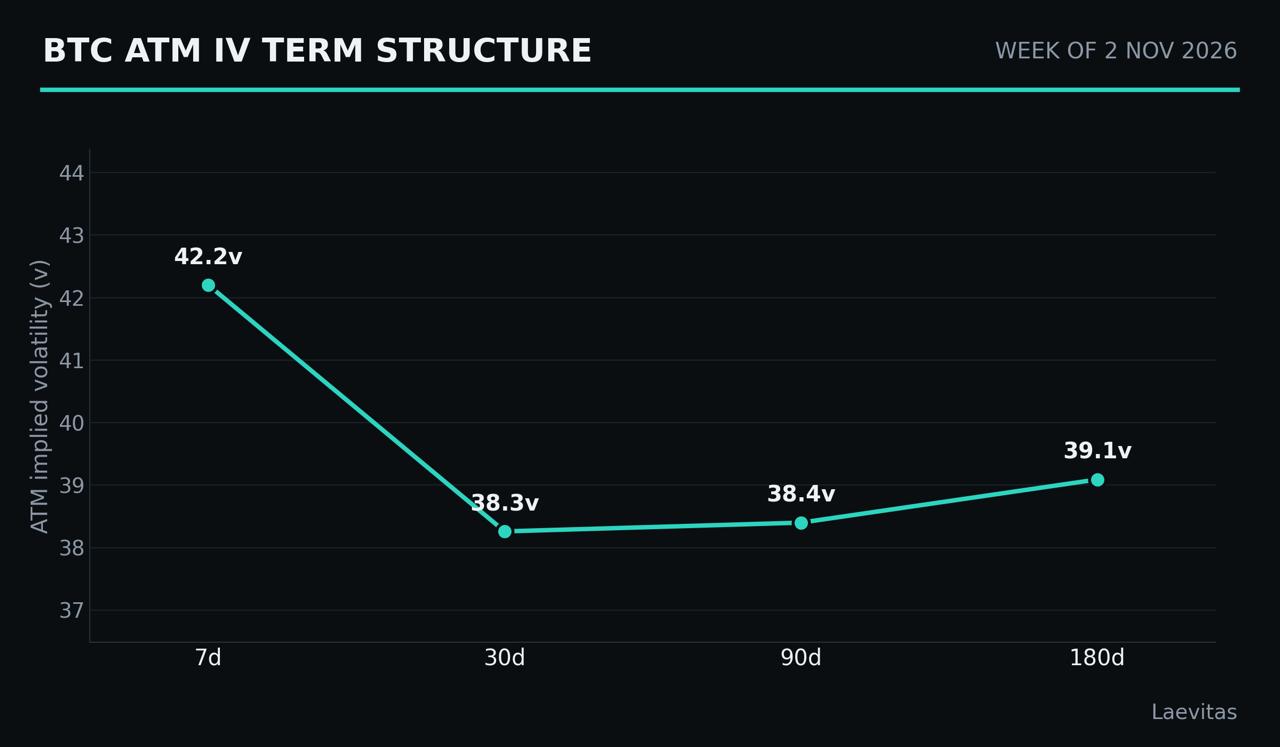
The $BTC surface has a pronounced front-end hump and the back end has barely moved. Term-structure ATM IV sits at 42.20v for 7d against 38.26v at 30d, 38.40v at 90d and 39.09v at 180d, an inversion of nearly 4v at the front of a curve that is otherwise flat to gently upward-sloping. The front end arrived there through a sharp repricing, with 7d IV printing 34.5v on 29 October, spiking to 46.5v on 30 October alongside the monthly expiry roll and bleeding to 42.20v since, while 30d has travelled only from 35.2v to 38.26v over the same stretch. That shape prices a specific event cluster and nothing beyond it. $ETH carries the same configuration with more amplitude, 56.66v at 7d against 51.62v at 30d, a 5v front-end premium on an asset whose 180d sits at 53.19v. The 30d butterfly at 1.09v on $BTC against 0.41v at 7d leaves the front-end wings relatively cheap against the body for anything that resolves inside the week.
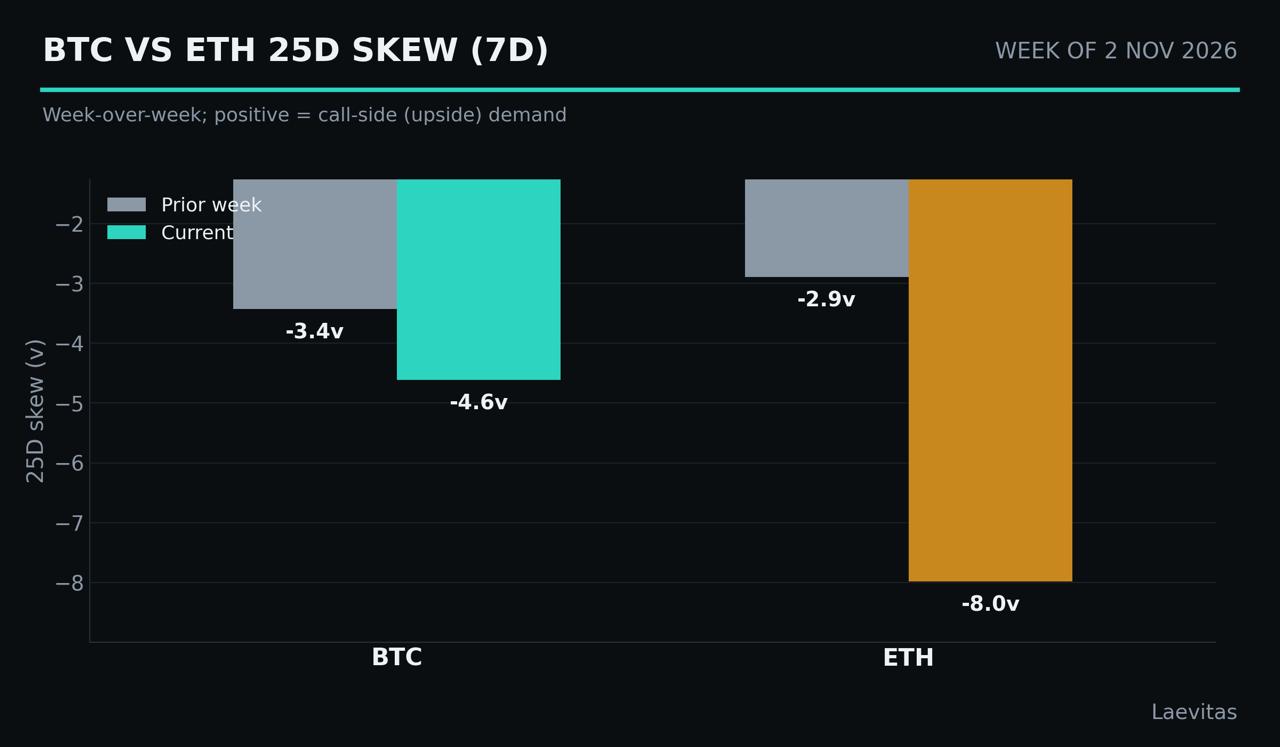
The skew move is where the week’s real repricing shows up, and it is overwhelmingly an $ETH story. The $ETH 7d 25D skew went from -2.89v to -7.98v in a week, which puts it at the 12th percentile of its 52-week range against a median of -3.75v, close to the put-bid extreme of its own year. $BTC moved far less over the same week, from -3.43v to -4.61v at 7d and from -4.64v to -4.87v at 30d, leaving both tenors at the 45th and 47th percentiles against medians of -4.18v and -4.63v respectively, which is an unremarkable mid-range put bid. The perp market corroborates the same asymmetry: $ETH funding flipped from roughly 7.0% annualised to -1.5%, a genuine regime break on 30 October with a run of consecutive negative prints behind it, while $BTC funding eased only from 9.9% to 9.2% annualised. Open interest held almost flat on both legs, $29,690MM in $BTC against $29,762MM a week earlier and $17,008MM in $ETH against $17,331MM, so the adjustment has come through the price of protection and the cost of carry while gross size stayed put. The weekly Deribit expiry on Friday coincides with the payrolls print, which concentrates the decay of that front-end premium into the same session as the week’s largest data risk.
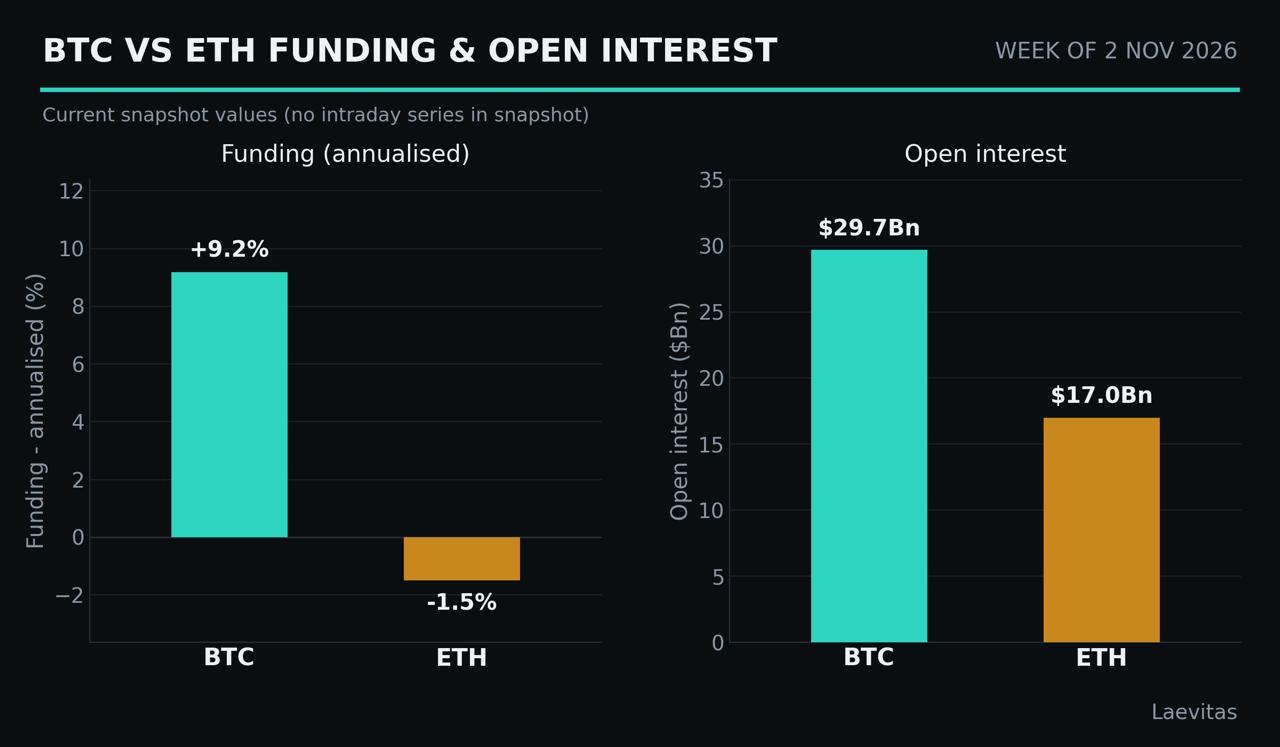
The tension is whether a 4v front-end hump on $BTC and a 12th-percentile put bid on $ETH are paying for a realised path that a week containing the midterms, the refunding announcement and payrolls can actually deliver, when the position base behind them has not changed size at all. Flat open interest alongside a funding flip and a five-point skew move describes hedging demand layered onto existing risk, and that kind of demand historically decays hard once the event it was bought for clears. The counterweight is that the energy-led inflation impulse keeps the December pricing intact, so the downside scenario for crypto beta arrives without the policy offset that long-dated positioning tends to assume, and the long-skewed account ratios of 1.41 on $BTC and 1.72 on $ETH show who would be wrong-footed if that path materialises.
Positioning into the week
- $ETH front-end put bid at the 12th percentile of its 52-week range: the -7.98v 7d skew holds while hedging demand persists into Friday’s expiry, and decays back towards the -3.75v median through the payrolls print once that demand has no event left to cover.
- $BTC front-end vol hump: 7d ATM IV at 42.20v against 38.26v at 30d is priced for the midterms, refunding and payrolls cluster, and the premium compresses if the realised path through the week stays inside what the 30 October spike to 46.5v already paid for.
- $ETH perp carry at -1.5% annualised against $BTC at 9.2%: the discount persists while the put bid and the short hedge behind it remain in place, and normalises towards the $BTC carry as that hedge is lifted into an account base still skewed long at 1.72.
- Flat open interest at $29,690MM in $BTC and $17,008MM in $ETH: the week’s repricing sits entirely in vol and funding, so a genuine positioning flush would announce itself through open interest falling away from those levels, with the skew widening only once that size has actually left.
- Energy as the binding macro input: Brent through $118/bbl keeps the December pricing intact and leaves crypto beta tied to the rates path, with the two-way diplomatic headline flow around Iran setting how much of that premium survives the week.
Rick, Head of Markets Week ahead | 2026-11-02 | Derivatives via Laevitas