
The Monday Brief // 09Nov26
Last week’s binding event resolved benignly in the end: the midterms handed the Democrats both chambers on Wednesday, and by Friday the tape was rebounding off an Iran deal headline that had Tehran willing to discuss ground it had previously ruled out - which is a long way from the post-election escalation the whole of the prior fortnight’s positioning was built around. That relief arrived only after an NDX session severe enough to drag the Kospi and the Nikkei down 6% apiece and put VVIX through its largest one-day move since early 2018, so the week closed with the macro risk defused and the AI complex still carrying the damage. Payrolls printed into that, with the BoE’s hawkish hike on Thursday - peak inflation forecast marked up to 4.9% from 3.2% - a reminder that the energy shock is still working through the G10 policy path whatever happens to the oil price.
Key events this week
Macro
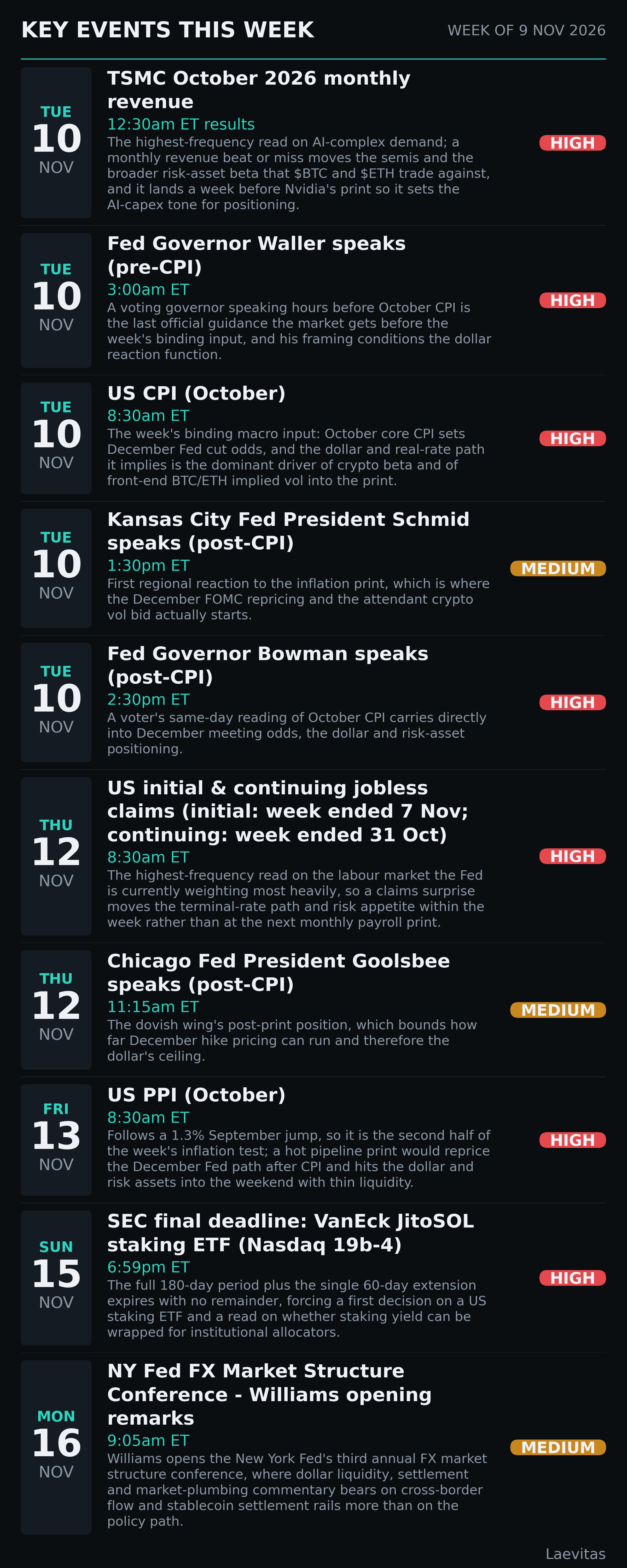
October CPI on Tuesday is the week’s binding input, and it lands into a configuration that has shifted materially in ten days. The hawkish case through late October rested on strong growth alongside elevated inflation; the case now has to contend with an equity drawdown that was severe enough to reprice the whole front end, an Iran negotiation that threatens the energy premium underpinning every G10 inflation forecast, and a Brent price that spent the first session of last week 4% lower on reports Hormuz could reopen inside two days. If the energy premium unwinds, the entire synchronised tightening thesis - the Fed on an every-other-meeting cadence, the ECB’s December signalling, the BoJ past its target for the first time in thirteen years, the BoC and the Riksbank already hiking - loses the supply-shock inflation that generated it. The configuration argues for a December hike still being the base case, but the conviction behind the 2027 path is weaker than it was a fortnight ago, and CPI is the first clean read on whether the goods pass-through from the shipping and freight channel has actually begun.
The more useful observation is that the transmission from rates into crypto has been rewired, and most of the market is still reading it the old way. Through October the daily correlation of 10-year Treasury moves to the Nasdaq ran at +0.60 while the correlation to Brent inverted to -0.28, which means a bond rally currently registers as a symptom of the AI complex cracking. That makes a falling 10-year yield the worst backdrop for high-beta crypto length; the genuinely constructive configuration has yields falling on de-escalation and inflation relief while equities hold, and that is precisely the combination a credible Iran framework would deliver. The dissent worth holding is on the AI capex question, where the debate has moved from how much capital gets deployed to who funds it and at what price - AI-related high-yield spreads widened some 78bp over the back half of October to around 400bp with CCCs at a four-year wide, and that credit curve carries the regime signal that matters for crypto beta.
Against that, the Fed speaker calendar is unusually dense on both sides of CPI - Bowman and Waller before the print, Bowman again after it, then Hammack and Williams on Thursday - and with the committee having just reduced the number of live meetings from 2027, each surviving communication carries more calibration weight than it used to. A twelve-week gap between decisions makes the speeches the policy path. The Chinese liquidity response to a decade-worst month in onshore equities is the quieter cross-asset input, with October credit data on Friday the test of whether it has reached the real economy.
Crypto
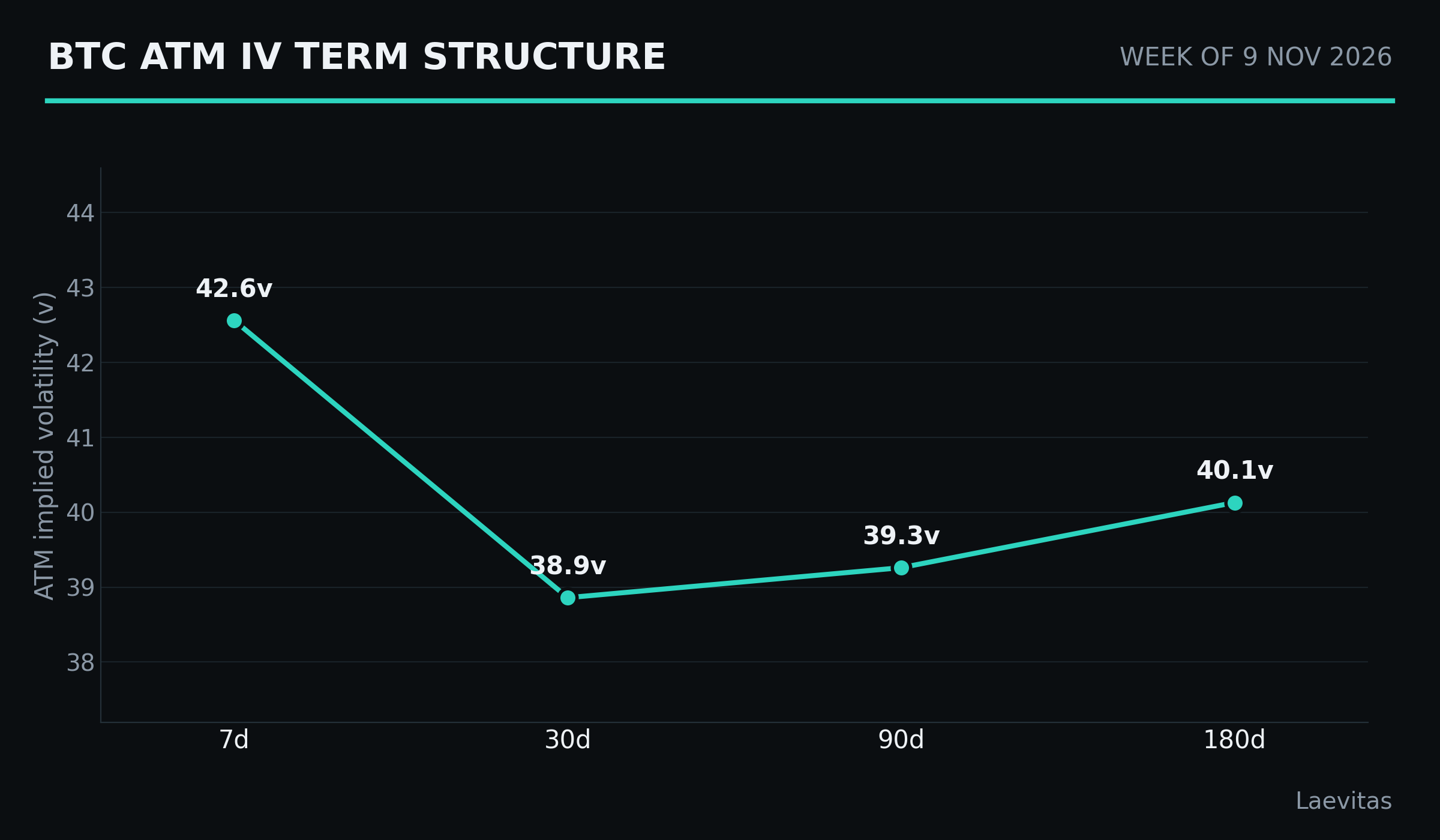
The vol surface is pricing the CPI print and very little else. $BTC 7d ATM IV sits at 42.56v against 38.86v at 30d, a 3.7v front-end inversion that is the steepest point of a curve otherwise flat from 30d out to 180d, and the path there was violent - the 7d print ran 34.3v on 5 November, 42.8v on the 6th, back to 37.2v on the 7th and up again to 42.6v this morning. That is an event premium repeatedly being bid and cut and bid again, and it sits almost entirely in the 7d bucket, which covers Tuesday’s CPI, Friday’s PPI and the Deribit weekly expiry around $1.85bn of $BTC notional. $ETH carries the same shape more steeply at 60.64v over 55.24v, and its realised leg is the more interesting one: on the IV-RV construction $ETH 7d realised is 62.1v against 59.5v implied, so short-dated $ETH optionality is being sold below what the coin has actually been delivering, while $BTC runs 41.0v realised under 42.4v implied on the same read.
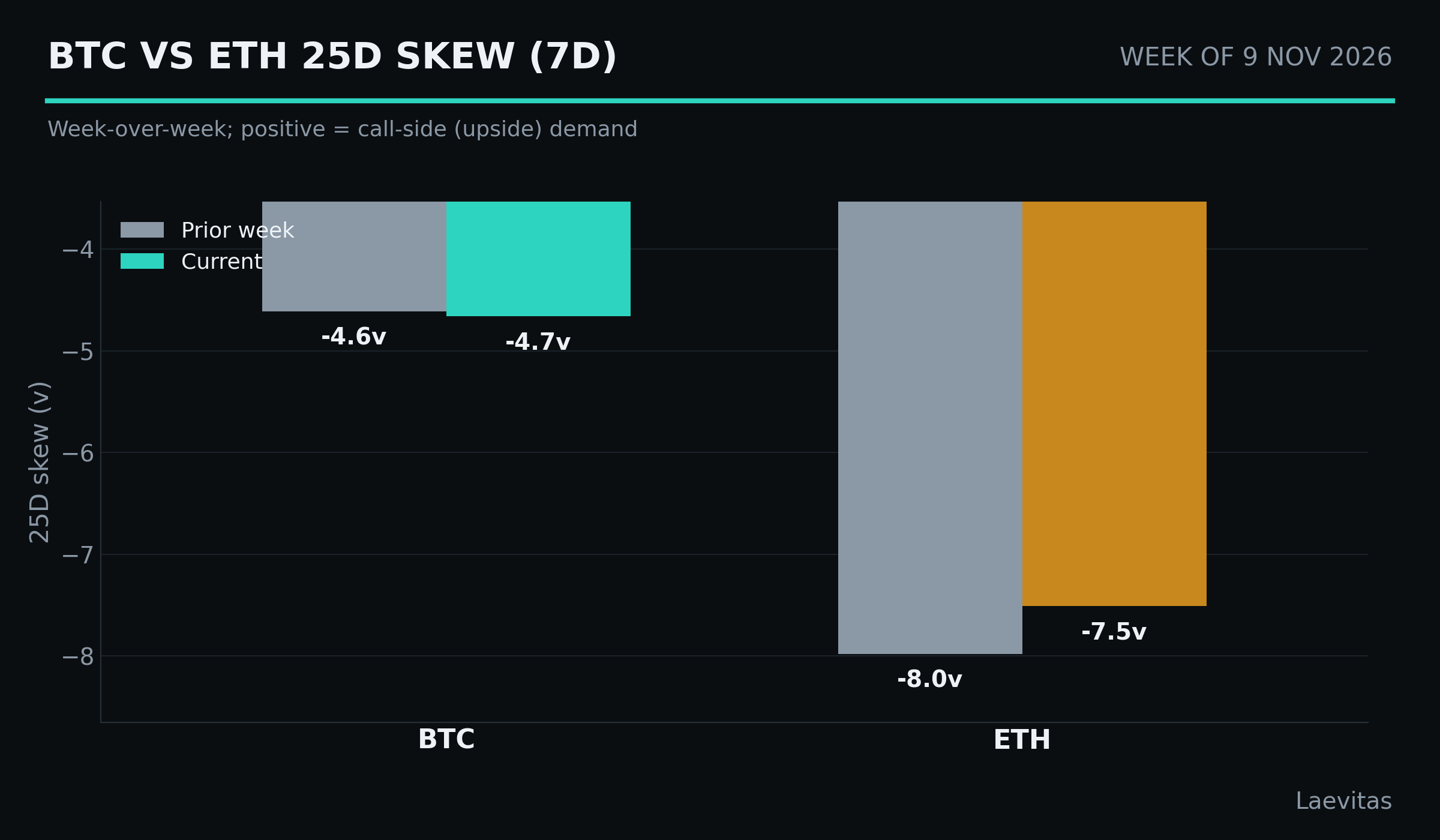
The skew move is the lead. $BTC 30d 25D skew ripped from -4.87v to -3.73v on the week and $ETH’s from -4.78v to -2.63v, a 1.14v and 2.15v compression respectively that takes both to the 67th and 69th percentile of their own 52-week ranges - and both remain less put-bid than their 52-week medians of -4.63v and -3.62v, so the move reads as a reversion out of the mid-range part of the distribution on $BTC, whose prior -4.87v sat only 0.24v beyond its median, and out of the moderately put-bid part of it on $ETH, whose prior -4.78v sat 1.16v beyond its own, leaving both tenors still priced on the put-bid side. The 7d buckets did not participate, with $BTC at -4.66v essentially unchanged and $ETH at -7.51v sitting at the 15th percentile of its range, so the term structure of skew has steepened sharply, with the 7d bucket retaining its put bid while the 30d bucket sits in the upper third of its own 52-week range. Open interest came off on both, $BTC down 2.3% to $29,015MM and $ETH down 10.5% to $15,229MM, while funding diverged outright - $BTC paying 10.7% annualised against $ETH at -5.9%, with a 2.46 long/short ratio on $ETH perps against a negative funding rate.
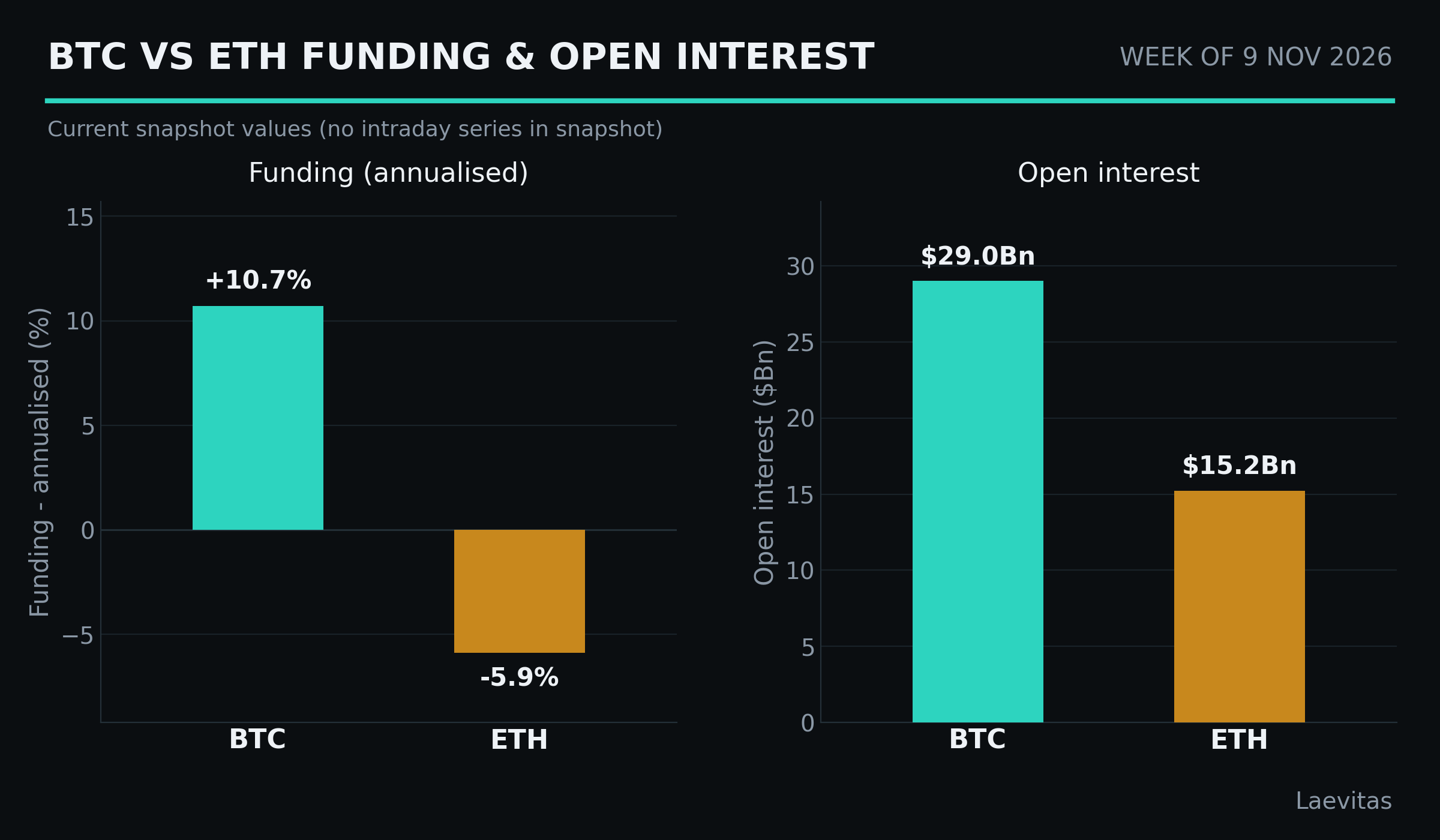
The tension is that the market has set up the compression trade and the macro backdrop no longer supports the thesis it was built on. A 30d skew reverting out of the mid-range part of its own distribution on $BTC and out of the moderately put-bid part of it on $ETH, open interest down a tenth on $ETH, and short-dated $ETH implied trading under realised together describe a book that has taken hedges off into a week whose binding input is a CPI print landing on a front end that has just repriced twice - once on an equity drawdown and once on an Iran headline. The configuration screens as short optionality into a two-sided catalyst, and the asymmetry runs against it. Validating the de-hedging requires a soft CPI landing alongside a credible Iran framework, the one combination that delivers lower yields with equities holding, and the rest of the distribution puts the December path back in play with the energy premium intact, against a 7d bucket that has already proved it will reprice 8 vols in a session. Negative funding on $ETH against a 2.46 long/short ratio says that positioning is leaning on the benign resolution arriving before the hedges are needed.
Positioning into the week
- $BTC front-end event premium: the 3.7v inversion of 7d over 30d ATM IV compensates for Tuesday’s CPI, Friday’s PPI and the Friday Deribit expiry inside one 7d window, and holds its value only while the CPI print retains two-sided risk.
- $ETH short-dated optionality against realised: 7d implied at 59.5v sits below 62.1v realised on the IV-RV read, a configuration that screens as cheap while the coin keeps delivering the realised vol its 60.64v ATM term-structure print implies.
- 30d skew reversion in both coins: $BTC at -3.73v and $ETH at -2.63v sit above their 52-week medians after a 1.14v and 2.15v weekly compression, leaving the month under-hedged if the energy premium holds through CPI.
- $ETH funding against positioning: perp funding at -5.9% annualised alongside a 2.46 long/short ratio means longs are being paid to hold risk, which persists only while the de-escalation path stays intact.
- Skew term structure steepening: $ETH 7d at -7.51v sits at the 15th percentile of its 52-week range against a 30d at the 69th, so near-dated downside protection stays bid into Tuesday while the 30d bucket has already unwound.
Rick @scopicview
Head of Markets, Laevitas
Week ahead | 2026-11-09 | Derivatives via Laevitas